


By Peace Orjiani — Enugu Online TV
Tension is rising in Enugu State following a deepening land dispute between the Etiti Ngwo community and government authorities over ownership of a contested area.
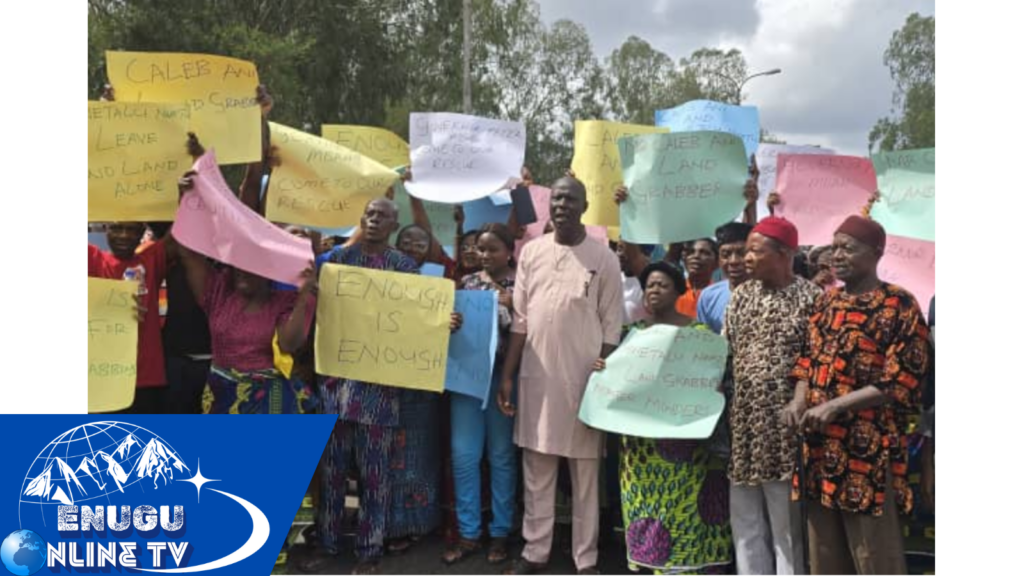
Leaders of the Etiti Ngwo community staged a peaceful protest on Monday, accusing officials of attempting to dispossess them of their ancestral land despite existing court judgments in their favour.
In a petition signed by the President General of the community, Daniel Eze, the protesters claimed that officials of the Enugu State Geographic Information System (ENGIS) and the Bureau of Public Enterprises (BPE) are working with a rival community to take over the disputed land.
The land in question, identified as Agu Ovolo, Isiama, and Ebemi, is said to have been in the possession of the Etiti Ngwo people for many years.
According to Eze, the ownership dispute had been settled through the courts, with judgments delivered in favour of the community by the Court of Appeal in 2015. He added that the ruling was upheld in 2021 when the Supreme Court dismissed an appeal filed by the rival Umuakum Atakwu village in Akwuke community.
Despite these rulings, the Etiti Ngwo community alleged that members of the rival group have continued to encroach on the land.
They further accused the Director of ENGIS, Chiwetalu Nwatu, of reallocating portions of the disputed land to the rival community in disregard of the court decisions.
The situation has heightened fears among residents, who say the dispute has created uncertainty and tension in the area.
The dispute reportedly turned violent on July 12, 2025, when a member of the Etiti Ngwo community, Sochima Onoh, was killed.
Community leaders alleged that the attack was carried out by youths from the rival community, further escalating tensions and raising concerns about safety.
Following the incident, the community called on Peter Mbah to intervene and order a full investigation into both the killing and the ongoing land dispute.
They also appealed for increased security presence to protect lives and property in the affected areas.
In response, the Enugu State Government dismissed the allegations, insisting that its actions were based on legal and administrative procedures.
The Senior Special Assistant to the Governor on Media, Dan Nwomeh, stated that the disputed land falls within the Olympic Layout and is classified as Crown Land.
According to him, the land was originally acquired during the colonial era and is now vested in the federal government.
Nwomeh explained that the Bureau of Public Enterprises (BPE) currently administers the land and has the legal authority to manage and allocate it.
He argued that neither Etiti Ngwo nor Akwuke community possesses a legally valid title to the land.
“Ownership cannot be transferred where no valid title exists,” he stated, adding that claims by both communities are legally defective.
He further clarified that court judgments obtained between the two communities do not override the superior ownership of the federal government, as such rulings apply only to the parties involved in the case.
The government also defended the role of ENGIS, stating that the agency only works in collaboration with the BPE to update land records and ensure compliance with urban planning regulations.
Nwomeh described this as a standard administrative process and not an attempt to dispossess any community.
Despite the government’s position, the dispute has continued to generate tension within the affected communities.
Residents fear that the situation could escalate further if not properly managed, especially given the history of violence linked to the land.
Many are now calling for urgent intervention, dialogue, and clarity on ownership to prevent further conflict.
The land dispute between the Etiti Ngwo community and government authorities highlights the complexities of land ownership in Enugu State, especially where ancestral claims conflict with government classifications.
As tensions rise, stakeholders are urging peaceful resolution, thorough investigation, and decisive action to prevent further violence and restore stability in the area.