


By Peace Orjiani
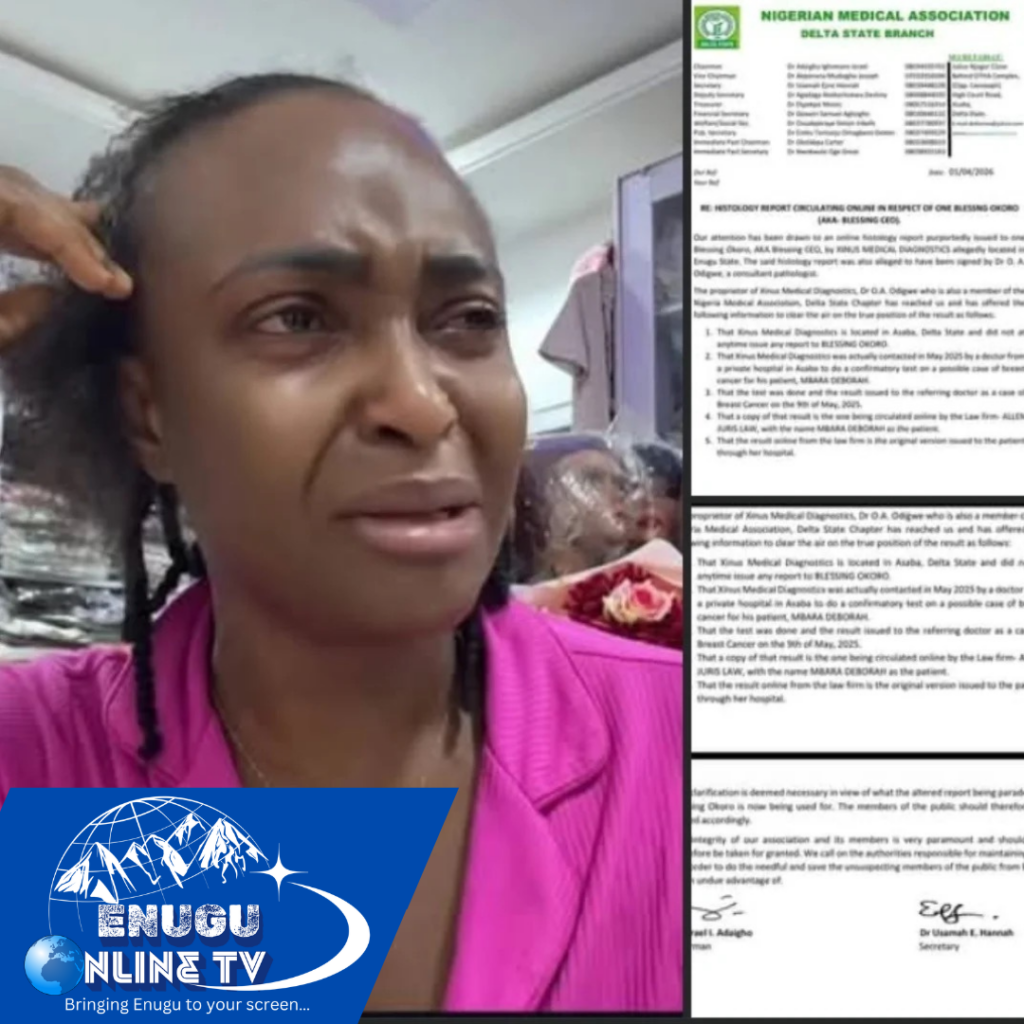
The new update about Blessing Okoro has taken another level and serious turn, following a fresh clarification from the Nigerian Medical Association and the doctor whose name appeared on the viral cancer report, Dr. O.A. Odigwe. What initially started as an emotional public revelation of a supposed stage 4 breast cancer diagnosis has now evolved into one of the most talked-about social media scandals in Nigeria in 2026.
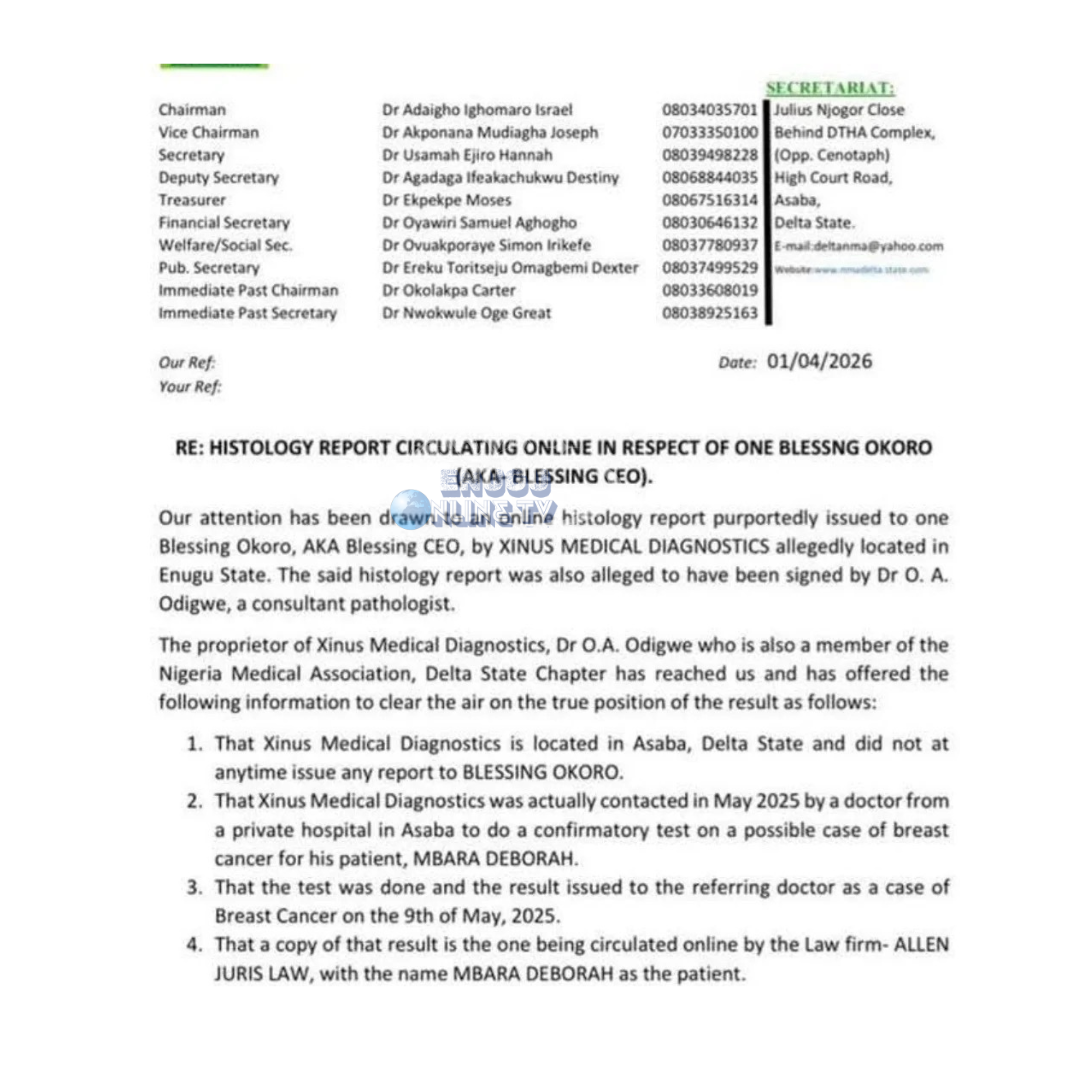
The Delta State branch of the Nigerian Medical Association (NMA) has clearly distanced itself from the medical report being circulated online by Blessing CEO, as confirmed by multiple credible reports and the official statement seen in the image you provided. According to the association, the document she presented was not only misrepresented but actually belonged to another patient entirely.
The NMA’s statement, signed by Chairman Dr. Israel Adaigho and Secretary Dr. Usamah Hannah, explained that the histology report in question was originally issued by Xinus Medical Diagnostics, a facility located in Asaba, Delta State, and not Enugu, as previously implied. This alone already contradicts earlier claims associated with Blessing CEO’s narrative.
More importantly, the association disclosed that the test was conducted in May 2025 for a patient identified as Mbara Deborah, who had been referred by a doctor from a private hospital in Asaba for a confirmatory breast cancer test. The result, issued on May 9, 2025, confirmed a case of breast cancer, but it was strictly tied to that patient, not Blessing Okoro.
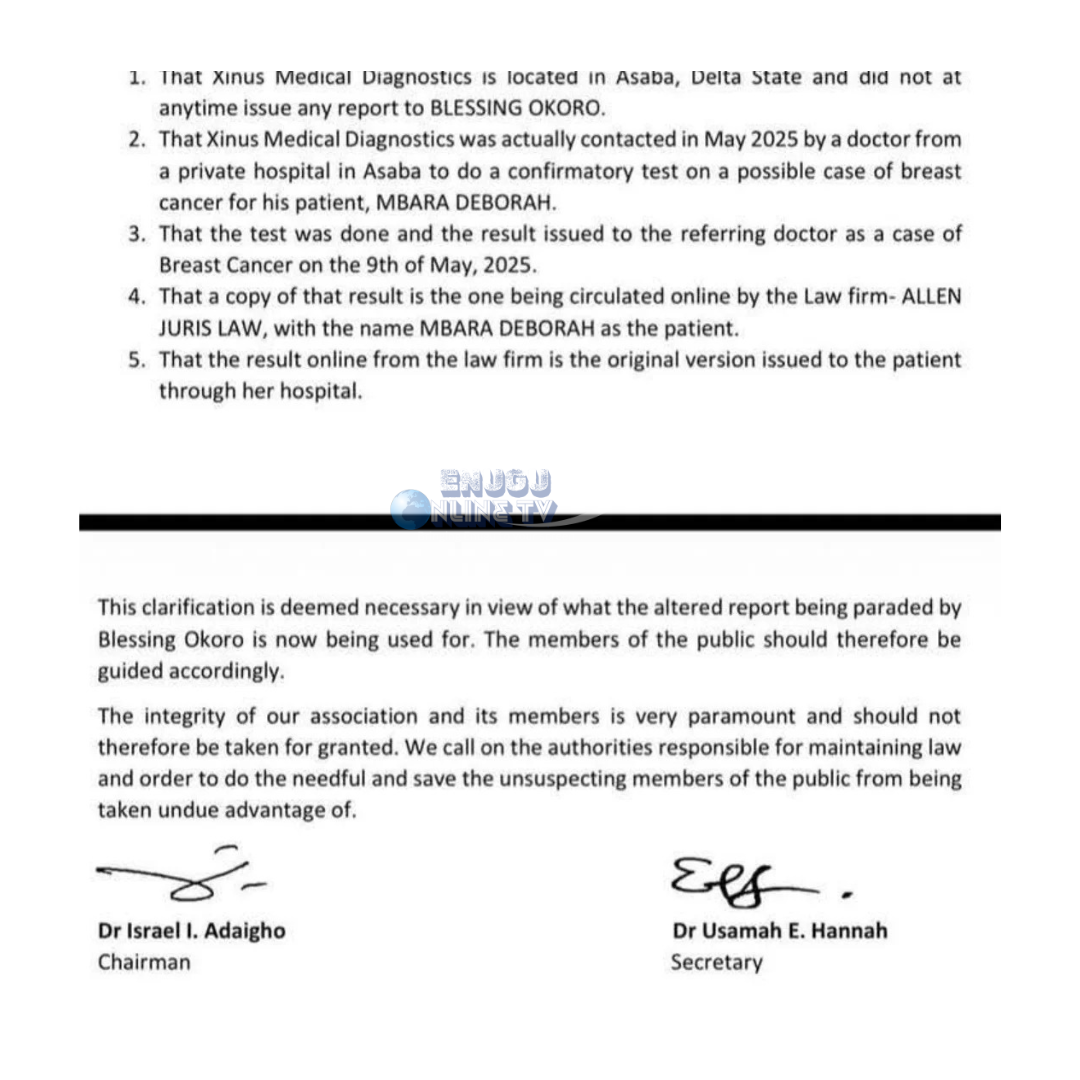
The next step is where the situation becomes even more serious. According to the NMA, the exact same report, bearing the name Mbara Deborah, was later seen circulating online through a law firm, Allen Juris Law, as the original and authentic version. However, what Blessing CEO allegedly shared publicly was an altered version of that same report, now carrying her own name.
The involvement of Dr. O.A. Odigwe is central to this unfolding drama. His name appeared on the report Blessing CEO presented, suggesting he was the diagnosing pathologist. However, Dr. Odigwe took a decisive step by personally contacting the NMA to clarify the situation. He categorically denied ever issuing any medical report to Blessing Okoro and stated clearly that he has no medical relationship with her.
He also addressed another key inconsistency, his location. Contrary to claims that he resides in Enugu, Dr. Odigwe confirmed that he is based in Asaba, Delta State. This further weakens the credibility of the narrative previously shared online and raises deeper questions about how the report was obtained and modified.
The NMA did not stop at just clarifying the origin of the report. In a strongly worded statement, the association warned the public to be cautious and not fall victim to misinformation. They urged authorities to act to protect their members and the medical field from exploitation.
This development is particularly significant because it confirms what many Nigerians on social media had already begun to suspect. When Blessing CEO first shared her emotional video claiming she had stage 4 breast cancer, the response was overwhelming. Many sympathized with her, while others donated money to support her treatment. Reports suggest she received millions of naira in donations, although she later claimed the total was around ₦13 million.
However, as scrutiny increased, inconsistencies in her story began to emerge. During interviews and live sessions, she struggled to provide clear medical explanations about her condition. At one point, she even walked back her earlier claim of stage 4 cancer, describing it as a possible misunderstanding rather than a confirmed diagnosis.
The situation escalated further when individuals, including the alleged original patient’s family, came forward claiming ownership of the report. This added another layer of complexity and turned the issue from mere social media speculation into a potentially serious legal matter.
On platforms like Instagram, Facebook, and X (formerly Twitter), reactions have been intense and divided. While some people still express sympathy, many others feel deceived and are calling for accountability. Some donors have reportedly demanded refunds, while legal experts have warned that if proven, the case could involve charges such as forgery, identity theft, and obtaining money under false pretences.
The broader implication of this controversy goes beyond just one individual. It touches on issues of trust, especially in an era where social media has become a powerful tool for influence and fundraising. When sensitive issues like health are involved, the stakes become even higher.
For the medical community, the incident is also a reputational concern. The unauthorized use of a doctor’s name and a legitimate medical report undermines public confidence in healthcare institutions. That is why the NMA’s swift response was necessary, not just to correct the narrative, but to protect the credibility of the profession.
As it stands now, the case is no longer just about online drama. It has entered the territory of possible legal investigation. The NMA has already called on relevant authorities to step in, and public pressure continues to mount for a thorough probe.

Some Social Media Responses
This is what is currently trending across platforms like Facebook, Instagram, Thread, and X, public sentiment appears to be largely critical, emotional, and, in many cases, outright angry. Nigerians are not holding back their opinions, especially given the sensitive nature of the issue of cancer.
Several comments reflect the level of outrage among users. One user, identified as “gladysomeife,” bluntly wrote, “This girl is a criminal.” Another commenter, “patricksundayej,” took it a step further by stating, “This girl deserves to spend time in jail.” These reactions show how quickly public sympathy has shifted to condemnation as more facts continue to emerge.
A user named “4chembay” offered a different perspective, emphasizing the emotional and moral implications of the situation. The comment read, “So this woman is mocking people who are battling with cancer. May God forgive her; she’s so wicked.” This particular reaction underscores a crucial reason why the issue has resonated so deeply: many individuals perceive it not merely as deception, but as a deeply insensitive act towards actual cancer patients and their families.
Another widely liked comment from “uchenna.sandra” took on a more reflective and almost spiritual tone: “When we started this year Hallelujah challenge, we were told that this year is judgement year, no practice of evil this year will go unpunished.” Comments like these show how the situation is being interpreted beyond just facts, with many linking it to broader themes of accountability and consequences.
Then there are those pointing out a pattern of behavior. A user named “gloriousfx1” wrote, “From the beginning, she claimed someone’s mansion as hers; now she is even claiming someone’s cancer medical report.” This comment suggests that for some members of the public, this controversy is not seen as an isolated incident but as part of a larger narrative surrounding Blessing CEO’s online persona.
Across social media, hashtags related to Blessing CEO have continued to trend, with thousands of posts analyzing every detail of the situation. Some users are sharing old videos and interviews, trying to identify inconsistencies in her statements. Others are demanding accountability, particularly from a legal perspective, while a smaller group is urging caution, reminding people not to make hasty conclusions until all perspectives are thoroughly considered.
What makes this situation particularly intense is how personal it feels to many Nigerians. Cancer is not just a topic; it is a lived reality for countless families. This is why the allegation that a medical report belonging to another patient, Mbara Deborah, may have been altered and presented as her own has sparked such widespread anger.
For Blessing CEO, this marks a critical moment in her public life. What started as a plea for empathy has now turned into a crisis of credibility. Whether she will respond further, provide verifiable medical evidence, or face legal consequences remains to be seen.
One thing is certain the involvement of Dr. Odigwe and the official statement from the Nigerian Medical Association have significantly shifted the narrative. The claim is no longer just “questionable”; it has been formally discredited by the institutions and professionals whose names were used.
As Nigerians continue to follow the story, it serves as a powerful reminder: in the digital age, truth may be delayed, but it rarely stays hidden for long.