

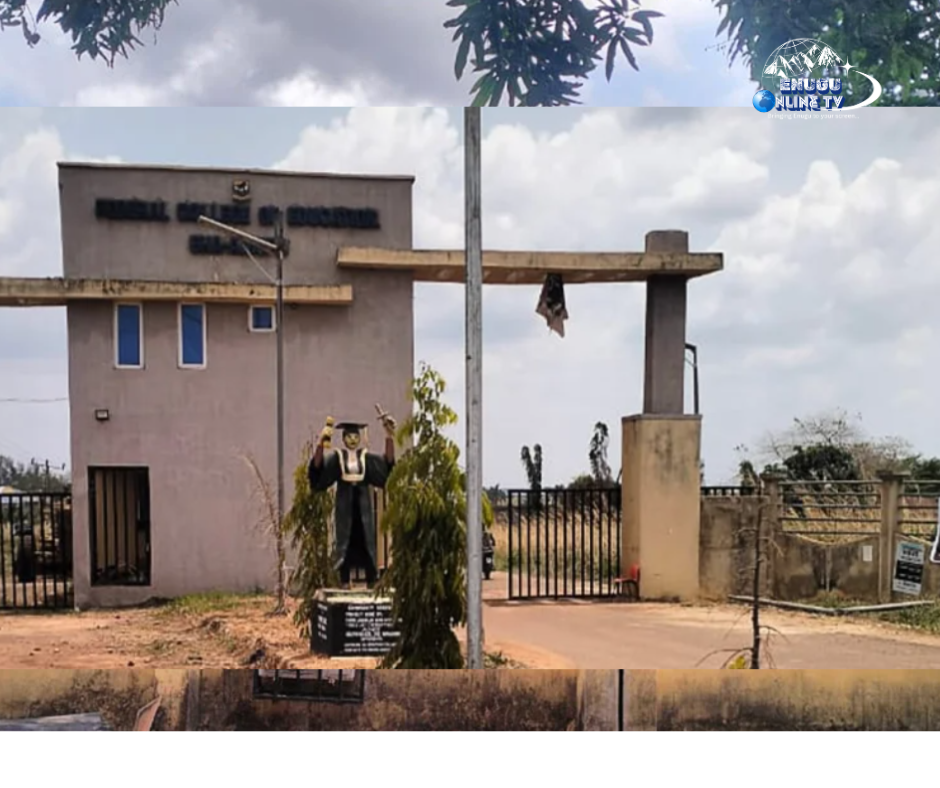
Despite ongoing efforts by the current management to reposition the 45-year-old Federal College of Education, Eha-Amufu, in Enugu State, the activities of vandals, arsonists, and other disruptive elements have continued to slow down progress at the institution. The situation has raised serious concerns about security, infrastructure, and the future of academic development within the college.
The Anambra State government established the college in 1981 to promote quality teacher education and ensure effective institutional management. In 1993, the federal government took over the school in a bid to strengthen its operations. This transition brought about improvements in infrastructure, staffing, funding, and training, helping the institution grow steadily over the years.
In recent times, the government further boosted the college’s capacity by granting it approval to award both diplomas and degrees in education. This move represented a significant advancement in aligning the institution with contemporary academic standards. However, persistent acts of vandalism, arson, theft, and land encroachment continue to disrupt operations, threatening these gains.
Located in the heart of Eha-Amufu, the college operates across three campuses, yet its open and unfenced environment has made it vulnerable to criminal activities. Hoodlums reportedly move freely within the premises, creating security challenges that have affected both staff and infrastructure.
One of the most damaging incidents occurred in the first week of March when a fire outbreak destroyed a multi-million-naira building that housed key administrative offices. The fire led to the loss of important documents and left many staff displaced, unsure of where to resume work. At the same time, reports indicated that while efforts were being made to control the fire, suspected arsonists took advantage of the situation to steal valuable items from other parts of the school.
According to the deputy provost, Dr. Samuel Odo, the fire completely razed a one-story building that contained the NCE exam unit, records unit, PDE unit, and the Council Chamber. He noted that the earlier relocation of the Procurement Unit spared it from the fire. He further explained that the incident mirrored a pattern observed in previous attacks, where distractions facilitated theft.
Dr. Odo revealed that on the morning after the fire, reports emerged that wires had been removed from the ICT unit in the School of Arts and Social Sciences, while the Music Department also suffered losses, with office equipment and wiring stolen. He added that in an earlier incident, while security personnel were busy containing a fire outbreak near the council area, criminals infiltrated the administrative block and removed three air conditioners, which were later recovered from nearby bushes.
Further investigations showed that the institution had already been plunged into darkness months earlier after vandals uprooted armored cables connected to the school’s transformer. The thieves stole the cables, worth millions of naira, leaving the college without a public electricity supply for over two months. This has forced the school to rely heavily on generators, increasing operational costs significantly.
To support students, the management placed a generator in the common room, allowing them to charge their devices during limited hours. However, the cost of fueling generators for both academic and general use has placed additional financial strain on the institution.
Water supply has also become a major challenge. Since 2023, the college has faced difficulties in accessing clean water due to the vandalism of its water treatment plant, valued at over ₦50 million. The ongoing trial follows the arrest of two suspects. In the meantime, the school depends on water tankers, sourcing water from the Ebonyi River, which is not considered safe for drinking. Students frequently queue with containers, anticipating water distribution.
Dr. Odo attributed the scale of these challenges to the porous nature of the campus, noting that the lack of fencing makes it difficult to control movement within the school. He emphasized the urgent need to secure the perimeter to prevent further attacks and protect both staff and students.
Despite these setbacks, the management asserts that the provost, Prof. Pauline Ikwuegbu, has made significant progress. According to Dr. Odo, the institution has benefited from multiple TETFund projects, including new infrastructure and staff development programs. He stated that over 80 staff members have participated in workshops and conferences sponsored by TETFund, contributing to academic growth.
The college has also explored alternative revenue sources, including agricultural ventures such as poultry and piggery, to support its operations. These initiatives, combined with improved facilities and academic expansion, have helped position the institution for long-term success.
Dr. Odo also addressed allegations of corruption and mismanagement circulating on social media, describing them as false and misleading. He defended the Provost, stating that the management has no involvement in the attacks on the school and that such claims are attempts to damage her reputation.
He specifically refuted claims that the provost diverted three buses meant for the college, explaining that the buses were constituency projects distributed to different schools, with proper documentation to support the allocation. He added that investigations confirmed the delivery of the buses to their intended beneficiaries.
On allegations related to TETFund, he maintained that all interventions are transparent and properly documented, noting that over 70 staff members have benefited from such programs between 2018 and 2024.
Reflecting on the Provost’s tenure, Dr. Odo praised her achievements, describing her as a transformative leader who has significantly improved the institution. He highlighted developments such as new hostels, upgraded classrooms, and improved internal roads, noting that her contributions have raised the standard of the college.
He also observed that controversies often arise towards the end of leadership tenures, driven by individuals with personal or political interests. However, he expressed confidence that the legacy of the current administration would endure despite ongoing challenges.
Overall, while the Federal College of Education, Eha-Amufu, has made notable progress recently, the persistent security threats and infrastructure damage caused by vandals and arsonists remain a major obstacle. Addressing these issues will be critical to safeguarding the institution’s future and ensuring that it continues to fulfill its mandate of providing quality teacher education.