
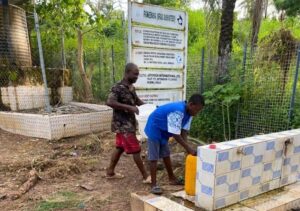

Conflicting narratives have emerged over the availability of potable water in Urukpa, Ezimo Community, Udenu Local Government Area of Enugu State, following reports alleging that residents depend on a contaminated stream for their daily water needs.
The controversy began after an online news platform reported that the community lacked a functional public water supply, forcing many households to rely on a stream for drinking, cooking and other domestic activities.
The report also referenced a letter dated June 13, 2026, purportedly written by the Unity and Growth Brotherhood Association, Urukpa, to the Deputy Governor of Enugu State, Barr. Ifeanyi Ossai, appealing for urgent intervention.
According to the publication, the association expressed concern that residents had for years depended on stream water, exposing them to the risk of waterborne diseases. While acknowledging the existence of an earlier borehole project, the group allegedly claimed it was not easily accessible to the wider community and appealed for either a new solar-powered borehole or unrestricted public access to the existing one.
The report further alleged that despite repeated assurances by successive governments, the community had yet to benefit from a sustainable potable water system, leaving many families with limited alternatives.
However, prominent leaders in Ezimo Community have dismissed the claims, insisting they do not accurately reflect the reality on the ground.
President of the Ezimo Unity Forum and Urukpa Brothers’ Movement, Charles Ndu, described the report as misleading, particularly the suggestion that residents share drinking water sources with cattle.
Ndu maintained that Urukpa has had functional boreholes long before Barr. Ossai assumed office as deputy governor and said additional water projects have since been attracted to the community.
He explained that the deputy governor facilitated the construction of a motorised borehole at the community’s agro-centre, while another borehole serves the local health centre. He added that the Smart Green School in the area also draws its water supply from one of the existing boreholes, with more water projects currently underway.
Although he acknowledged that the rocky terrain in parts of Urukpa has made successful borehole drilling difficult in some locations, he stressed that this does not mean residents depend on streams for potable water.
Ndu further noted that one of the streams featured in the report naturally flows from rock formations and is used by some residents out of preference. He added that while the water may appear muddy after heavy rainfall, the claim that it is contaminated by grazing cattle is inaccurate.
He urged journalists to uphold professional standards by verifying information before publication.
Echoing the same position, former councillor and immediate past President of the Ezimo Unity Forum, Onyekachi Ugwu, said Urukpa currently has seven boreholes, with five functioning effectively to meet the community’s water needs.
Ugwu listed the operational facilities as the Ozara ADB Borehole, Amaogbele CSDA Borehole, Urukpa ATASP Solar-Powered Borehole, Urukpa IFAD Borehole and the Amallogbo/Amogu Udenu Local Government Borehole. He explained that only two older boreholes are presently non-functional.
He also disclosed that another borehole project has already been approved for the community, while plans to provide a borehole for the Type 2 Healthcare Facility at Ibagwa-Ezimo are awaiting the resolution of technical challenges.
Ugwu encouraged members of the public and the media to visit Urukpa to independently verify the state of water infrastructure before drawing conclusions.