
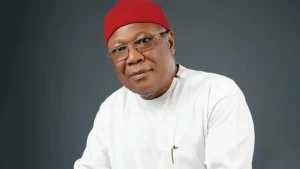

Former Nigerian Ambassador to Germany, Portugal, Cuba and Ghana, Simon Ejike Eze, says his decision to join partisan politics was inspired by the same commitment to public service that shaped his years in the diplomatic corps.
Speaking with LEO SOBECHI, Eze described the recent Enugu North Senatorial by-election as a troubling test of Nigeria’s democratic process. He alleged that Governor Peter Mbah’s move to the All Progressives Congress (APC) had transferred what he called the Peoples Democratic Party’s (PDP) politics of imposition and impunity into the ruling party.
On the conduct of the Enugu North by-election
Eze said the election left him deeply disappointed, noting that he never expected to witness such developments in a democratic setting.
According to him, Enugu’s political culture for many years was dominated by what he described as the “Ojebego” mentality, where the preferred candidate of the political establishment was widely believed to emerge victorious regardless of the electoral process.
He argued that the 2023 general election, fuelled by the Obidient Movement and Peter Obi’s presidential campaign, disrupted that pattern by proving that voters could elect candidates outside the traditional political structure.
However, Eze claimed the recent by-election reflected a return to old political practices. In his view, the APC-led administration in the state has embraced methods previously associated with the PDP.
He explained that as one of the founding members of the APC in Enugu, he expected fairness after expressing interest in the senatorial ticket. Despite several attempts to engage party leaders, he said he was unable to secure a meeting or receive what he considered equitable treatment. That experience, he noted, prompted him to pursue his ambition on another party’s platform.
He further alleged that the election was marred by intimidation, violence and widespread voter harassment, adding that fear kept many residents away from polling units and contributed to poor turnout.
Eze also questioned the APC’s candidate selection process, insisting that it lacked transparency and was based on imposition rather than open competition. He contrasted this with his emergence through what he described as a recognised primary election in another political party.
Although he acknowledged Senator Ikeje Asogwa’s victory and respected his office, Eze maintained that the outcome would likely have been different if the election had been conducted under freer and fairer conditions.
He also expressed doubts over the official figures released, saying the votes credited to the APC candidate appeared inconsistent with the turnout he personally observed across polling units.
On claims of wider popularity
Asked whether he believed he was a stronger candidate than the eventual winner, Eze described it as his personal conviction.
He stressed that his remarks were not intended as a personal attack on the senator but argued that his own long-standing relationship with communities across Enugu North gave him broader grassroots support and greater visibility within the district.
Concerns ahead of the 2027 general election
Looking ahead, Eze warned that if the same pattern witnessed during the by-election is repeated nationwide, the credibility of the 2027 elections could come under serious scrutiny.
He observed that while the APC currently controls both the Federal Government and Enugu State, a general election would involve more participants and make it harder for any single political interest to dominate the process.
He also noted that the strength of candidates would influence the outcome. In particular, he believes Peter Obi would remain a significant political force in the South-East if he contests again, although he acknowledged that only time would determine whether the momentum of 2023 would continue.
Eze further expressed concern over the neutrality of election officials, claiming that some ad hoc personnel appeared politically aligned. According to him, public trust in elections depends heavily on the perceived independence of both electoral officials and security agencies.
While he has not ruled out contesting again under the Labour Party, he said confidence that votes would genuinely count would be a major factor in deciding his next political move.
Views on the Electoral Act 2026
Although Eze admitted he had not examined every section of the Electoral Act 2026, he said discussions with legal experts and his personal experience left him with concerns.
He believes some of the safeguards that previously strengthened election transparency may have been weakened, particularly where manual procedures are permitted when technology fails.
He also questioned whether innovations such as BVAS and the IReV portal are being deployed as effectively as in previous elections.
According to him, some lawyers have argued that the new legal framework limits the grounds upon which election results can be challenged. If that interpretation is accurate, he warned, it could make legal redress more difficult for aggrieved candidates.
For that reason, he advocated stronger legal protections that enhance transparency and reinforce public confidence in elections.
Why he is unlikely to challenge the result
Eze said he has decided against filing an election petition, citing the financial and emotional burden of election litigation.
He noted that although election cases have statutory timelines, the legal process often drags on for months while requiring enormous financial commitment.
Rather than pursuing the matter in court, he said he would focus on preparing for future political opportunities and contributing to democratic reforms.
Five steps towards credible elections in 2027
Eze identified five priorities that, in his view, would improve Nigeria’s electoral process.
First, he urged all eligible Nigerians to register and obtain their Permanent Voter Cards (PVCs).
Second, he appealed to citizens to overcome voter apathy, arguing that higher voter participation makes electoral manipulation more difficult.
Third, he called on the Independent National Electoral Commission (INEC) to safeguard its independence by ensuring impartial conduct at every level.
Fourth, he encouraged voters to reject vote-buying and make electoral choices based on competence, integrity and the ability to deliver good governance rather than financial inducements.
Finally, he advised political parties to strengthen their election-day operations by deploying trained polling agents capable of monitoring the process effectively and within the law.
Drawing from his own experience, Eze said proper representation at polling units is essential to protecting electoral integrity.
Reducing the influence of money in politics
On campaign financing, Eze argued that the rising cost of elections has encouraged many politicians to see public office as an investment to be recovered after victory.
He maintained that while Nigeria already has laws regulating campaign spending and outlawing vote-buying, enforcement remains weak.
He called on security agencies and electoral officials to ensure that money is not distributed around polling units and insisted that anyone found violating electoral laws should be investigated and prosecuted without regard to political affiliation.
Referring to allegations surrounding the Enugu North by-election, Eze said reports of financial inducements should not be ignored, warning that failure to investigate such claims would further erode public confidence in the electoral process.
He also expressed concern that party agents in some polling units allegedly did not receive copies of election results immediately after voting, arguing that failure to follow laid-down procedures naturally raises suspicion.
According to him, Nigeria’s democracy will only mature when elections are conducted transparently and citizens are confident that their votes truly determine who governs them.