






By Isaac Mission
The 2026 Appropriation Act has come under fresh scrutiny following reports that the National Assembly approved about N29.59 billion for electricity-related projects under the budget of the Federal Co-operative College, Oji River, Enugu State—an institution whose primary responsibility is cooperative education and management.
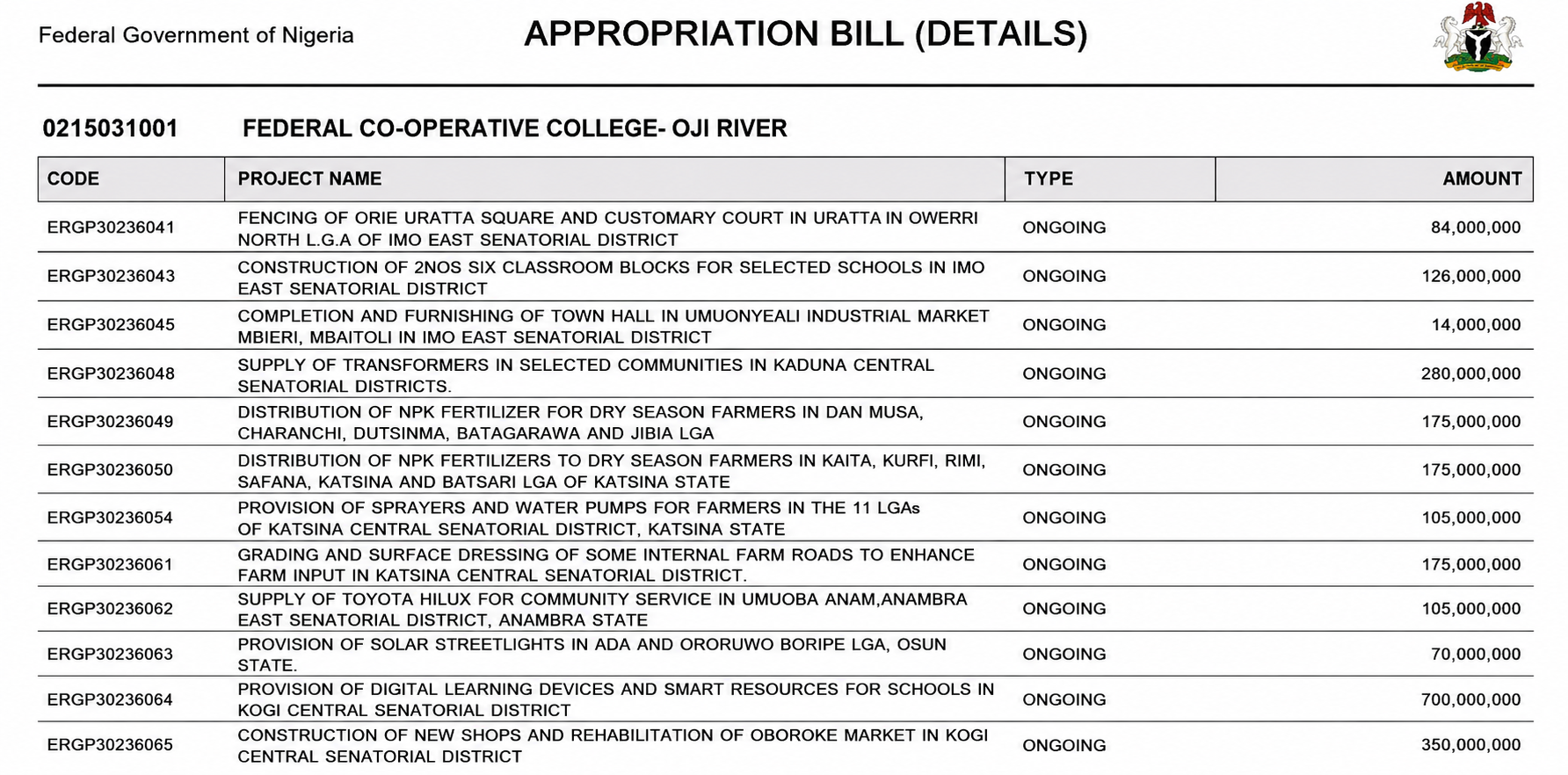
A review of the approved budget indicates that the college received a total allocation of N226.77 billion, with N225.63 billion designated for capital projects. Buried within that capital allocation are numerous constituency-style projects involving the installation of solar street lights, transformers, mini-grids, rural electrification, and other energy infrastructure across several states.
The projects, which appear in the 2026 budget document, cover communities in virtually every geopolitical zone, including Rivers, Lagos, Ogun, Cross River, Kaduna, Sokoto, Katsina, Adamawa, Taraba, Imo, Delta, Anambra, Enugu, Osun, Oyo, Akwa Ibom, Bayelsa, Ebonyi and many others.
The Federal Co-operative College, according to information published on its official platform, is established to provide education, training and professional development in cooperative studies and management. Its statutory functions do not include the execution of nationwide electricity or public infrastructure projects.
Among the largest allocations is N1.4 billion for the construction of transformer substations in selected rural communities across the country. Another N1.05 billion is earmarked for electrification projects in communities within Tai Local Government Area of Rivers State, while an additional N1.05 billion is allocated for solar street-light installations across selected locations in Ogun State.
Other notable provisions include N700 million for solar street-light projects in Enugu East Senatorial District, as well as three separate allocations of N700 million each for the completion of sports complexes with motorised boreholes, floodlights and solar-powered street lights in different communities in Ekiti State.
Further allocations include N700 million for solar lighting along rural farm roads in Imo and Anambra states, another N700 million for the Ukpo–Abagana Link Road in Anambra, and N700 million for solar-powered street lights across communities in Osun West Senatorial District.
The budget also contains hundreds of millions of naira for transformer installations, renewable energy projects, solar mini-grids, grid extensions, feeder pillars, electricity reticulation and security lighting in communities across the country. Individual project values range from N7 million to more than N1 billion.
Several projects focus on rural electrification and solar-powered infrastructure in communities across Abia, Akwa Ibom, Bayelsa, Cross River, Delta, Edo, Ekiti, Enugu, Imo, Kano, Katsina, Nasarawa, Ogun, Ondo, Oyo, Rivers and Zamfara states.
Analysts have questioned why these projects were placed under the budget of an academic institution whose legal mandate is limited to cooperative education. They argue that assigning infrastructure projects to agencies without the statutory responsibility or technical capacity to execute them could complicate project monitoring, weaken accountability and increase the risk of abandoned or poorly supervised projects.
Concerns have also been raised that such budgetary insertions make oversight more difficult, as institutions are required to manage projects that fall outside their areas of expertise and operational mandate.