





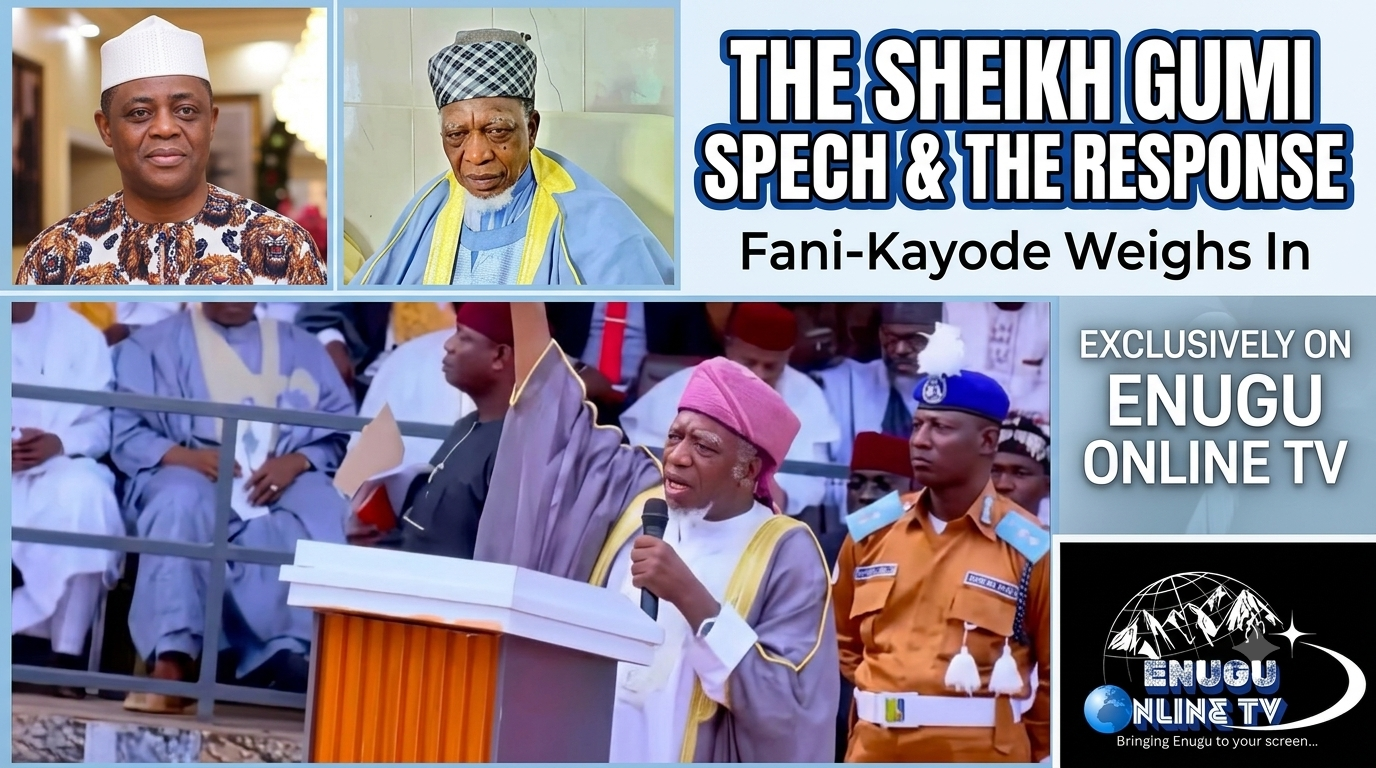
By Faith Eze
A fresh debate over religion and politics has emerged in Nigeria following comments attributed to Plateau-based Islamic cleric, Sheikh Yahaya Jingir, concerning the country’s religious identity and the possibility of another Muslim-Muslim presidential ticket in the 2027 general elections.
The comments have attracted significant attention on social media, with former Minister of Aviation and Nigeria’s High Commissioner-designate to South Africa, Femi Fani-Kayode, responding strongly to the position expressed by the cleric.
Fani-Kayode described the rhetoric attributed to Sheikh Jingir as provocative and potentially dangerous to national unity. He also urged Nigerians not to allow religious differences to divide the country.
The development comes at a time when political parties and politicians are already beginning to position themselves ahead of the 2027 presidential election.
What Did Sheikh Jingir Say?
According to reports about the viral video, Sheikh Yahaya Jingir spoke at a gathering where he discussed the Muslim-Muslim presidential ticket and encouraged Muslims to continue supporting the arrangement ahead of the 2027 election.
The cleric reportedly praised President Bola Ahmed Tinubu for introducing the Muslim-Muslim presidential ticket in the 2023 election and described himself as a supporter of the political arrangement.
He was also reported to have urged Muslims to obtain their Permanent Voter Cards and participate actively in the 2027 election.
The comments generated reactions because of the sensitive nature of religion and politics in Nigeria. The country has a large Muslim and Christian population, and questions about religious balancing have traditionally played an important role in political discussions.
Jingir’s comments subsequently became widely circulated online, leading to criticism from some Nigerians and a response from Fani-Kayode.
Fani-Kayode Pushes Back
Reacting to the comments, Fani-Kayode said that although he has respect for Sheikh Jingir, he disagreed with what he described as extreme rhetoric.
The former minister argued that statements that could create religious division should be avoided, particularly in a country as diverse as Nigeria.
Fani-Kayode stressed that Nigeria should not be viewed as belonging exclusively to either Muslims or Christians.
His argument was based on the idea that Nigerians should place their national identity above religious differences.
He also said that supporting a Muslim-Muslim ticket does not necessarily mean that his support is based on religion.
According to Fani-Kayode, his support for President Tinubu and Vice President Kashim Shettima’s political arrangement was based on what he described as their competence, character, ability and electoral strength rather than their religious identities.
The Question of Nigeria’s Religious Population
One of the major issues raised by the controversy is the question of whether Muslims or Christians constitute the majority in Nigeria.
This is an area where figures must be treated carefully because Nigeria does not have a recent official census that provides a definitive religious breakdown.
However, estimates from the Pew Research Center, published in November 2025, estimated that Muslims represented about 56.1 percent of Nigeria’s population in 2020, while Christians represented about 43.4 percent. Pew also noted that Nigeria’s religious composition has been difficult to measure because the country has not had a recent census that officially records religion.
Therefore, claims about Nigeria being entirely a Muslim or Christian country can oversimplify a much more complicated reality.
Nigeria is home to millions of Muslims and Christians, as well as people who practise traditional African religions and other beliefs.
More importantly, Nigeria’s Constitution does not establish Islam or Christianity as the state religion. Section 10 provides that the federal or state government shall not adopt any religion as a state religion. The Constitution also provides protections against discrimination based on religion.
Why the Muslim-Muslim Ticket Remains Controversial
The Muslim-Muslim ticket became one of the biggest issues during the 2023 presidential election.
President Bola Tinubu, a Muslim from the South-West, selected Kashim Shettima, a Muslim from the North-East, as his running mate.
Supporters argued that political competence and the ability to govern should be more important than religious considerations.
Opponents, however, argued that Nigeria’s religious diversity should be reflected in the country’s highest political office.
The debate is now returning as politicians and political groups prepare for the 2027 election.
Fani-Kayode’s latest comments therefore come at a politically sensitive time.
Fani-Kayode Calls for National Unity
One of the major points in Fani-Kayode’s response was his appeal for Nigerians to remain united.
He argued that Nigerians should not allow religion to become a reason for citizens to turn against one another.
This is particularly important because Nigeria has experienced serious tensions involving religion, ethnicity, politics and regional interests over the years.
Political disagreements are normal in a democracy, but religious rhetoric can become especially sensitive because it affects people’s identities and beliefs.
The former minister therefore encouraged Nigerians to concentrate on issues such as leadership, competence, development and the future of the country.
Fani-Kayode’s New Diplomatic Role
The controversy is also attracting attention because of Fani-Kayode’s new diplomatic position.
Fani-Kayode was appointed by President Tinubu as Nigeria’s representative to South Africa. In July 2026, reports confirmed that he had received his Letters of Credence, paving the way for him to serve as Nigeria’s High Commissioner to South Africa, Lesotho and Eswatini.
His new role means that his public statements may attract even more attention, particularly when they concern issues involving Nigeria’s image, unity and international relations.
A Debate Bigger Than One Political Party
The disagreement between Fani-Kayode and Sheikh Jingir goes beyond the two individuals.
It reflects a much larger debate about the place of religion in Nigerian politics.
As the 2027 election approaches, Nigerians are likely to hear more arguments about whether political candidates should be selected based on religion, region, competence, experience, party loyalty or electoral strength.
For many Nigerians, the bigger question will be whether political leaders can compete strongly without turning religious differences into sources of division.
Nigeria is a country of many ethnic groups, languages, cultures and religious beliefs. Its diversity can either become a source of strength or a source of tension, depending on how political and religious leaders use their influence.
Conclusion
The exchange between Femi Fani-Kayode and Sheikh Yahaya Jingir has once again brought religion and politics to the centre of public discussion in Nigeria.
While Sheikh Jingir’s reported comments have been interpreted by critics as support for another Muslim-Muslim ticket in 2027, Fani-Kayode has argued that Nigerians should not allow religion to divide them.
The former minister has also maintained that political choices should be based on leadership qualities, competence and the ability to deliver results rather than simply on religious identity.
With the 2027 elections approaching, the conversation is unlikely to disappear soon.
For Nigerians, the challenge will be to participate actively in political discussions while respecting people of different faiths and backgrounds.
Whatever political party or candidate Nigerians eventually support, the country’s unity remains important. The debate over the Muslim-Muslim ticket may continue, but it is equally important that political disagreements do not become religious hostility.
Nigeria’s future ultimately belongs to all Nigerians — Muslims, Christians and people of other faiths — and the country’s political process must reflect that diversity.