







By Isaac Mission
Twelve companies listed on the Nigerian Exchange Limited (NGX) recorded a combined 16.9 per cent increase in cost of sales and operating expenses (OPEX) to N10.14 trillion in the first half of 2026, reflecting continued pressure from inflation, exchange-rate movements and rising operating costs.
Analysis of the companies’ unaudited financial statements for the six months ended June 30, 2026 showed that their combined cost of sales rose to N7.67 trillion, compared with N6.60 trillion recorded in the corresponding period of 2025.
Similarly, operating expenses increased to N2.47 trillion, up from N2.20 trillion a year earlier.
The combined increase in cost of sales and OPEX was slightly higher than Nigeria’s 15.91 per cent inflation rate for June 2026, indicating the continued impact of higher input and operating costs on businesses.
Despite the cost pressures, the naira recorded relative improvement during the period. It closed the first half of 2026 at about N1,380 to the dollar, compared with N1,530/$ at the end of June 2025.
The companies, however, recorded significant growth in profit before tax, which rose to N4.95 trillion in H1 2026 from N2.84 trillion in the same period of 2025.
Rising Cost Pressures
Industry analysts attributed the increase in operating expenses and cost of sales to several factors, including inflation, electricity costs, transportation, raw materials and other production-related expenses.
Global supply-chain disruptions and geopolitical tensions have also continued to influence the cost of imported raw materials and other commodities, adding pressure to manufacturers and other businesses operating in Nigeria.
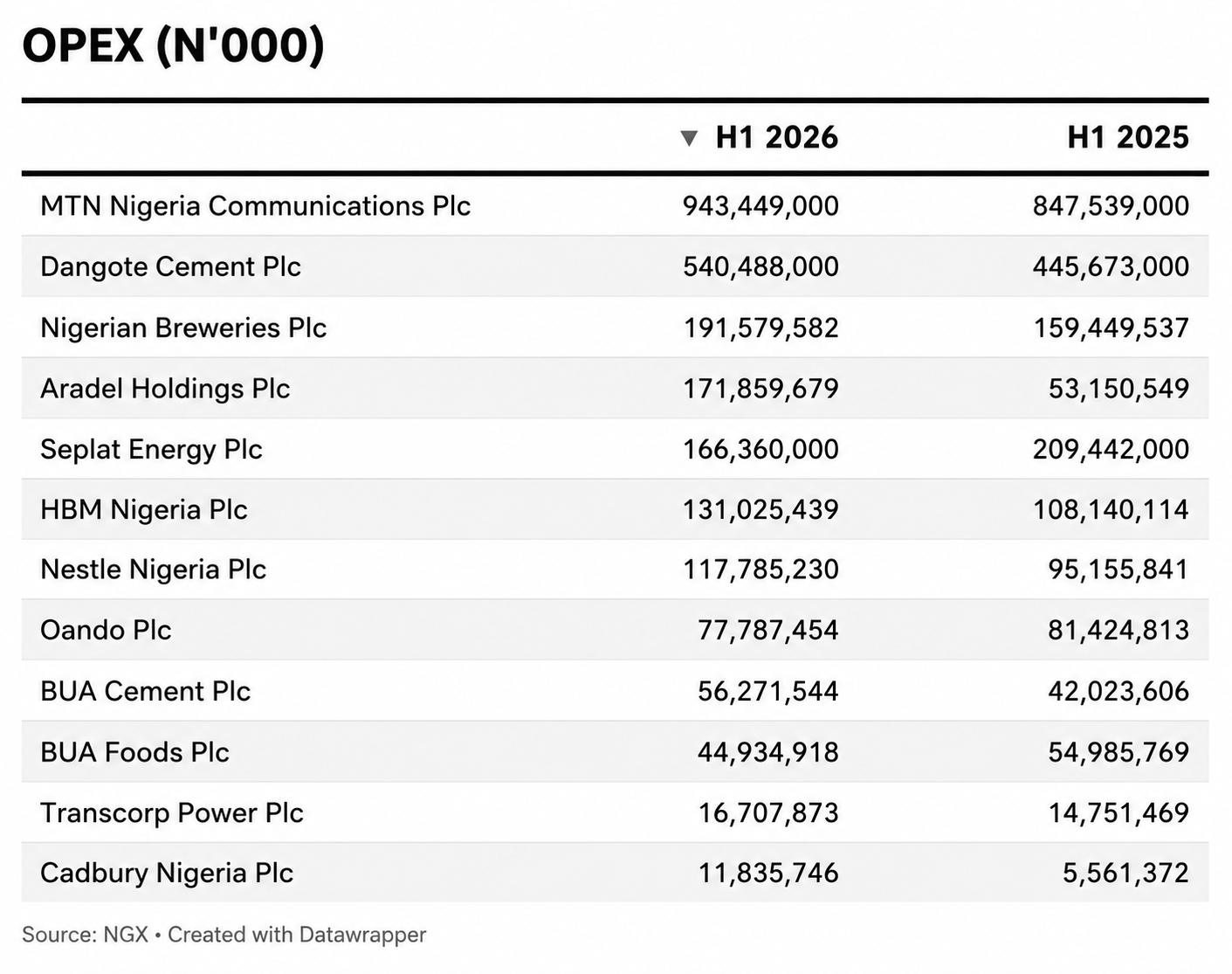
Among the 12 companies analysed, Oando Plc, Seplat Energy Plc, Dangote Cement Plc and MTN Nigeria Communications Plc recorded some of the highest combined cost of sales and operating expenses during the period.
Oando reported N1.96 trillion in cost of sales, representing an increase of about 15.6 per cent from N1.70 trillion in H1 2025. However, its administrative expenses declined by 4.5 per cent to N77.8 billion from N81.4 billion.
The indigenous oil and gas company nevertheless reduced its loss before tax significantly, reporting N32.84 billion in H1 2026 compared with a loss of N145.74 billion in the corresponding period of 2025.
For Seplat Energy, cost of sales declined by 2.47 per cent to N1.38 trillion, from N1.42 trillion in H1 2025. Its operating expenses also fell by about 21 per cent to N166.36 billion, compared with N209.44 billion recorded a year earlier.
Dangote Cement, meanwhile, posted N924.31 billion in cost of sales, representing an 8.3 per cent increase from N853.6 billion in H1 2025.
The company’s operating expenses rose by 21.2 per cent to N540.5 billion, compared with N445.67 billion in the corresponding period of 2025.
Analysts Warn of Possible Impact on Dividends
Analysts said the rising cost structure could put pressure on companies’ earnings and potentially affect dividend payments to shareholders, particularly if operating expenses continue to increase.
They also warned that businesses could face additional cost pressures as the country approaches the next election cycle, when increased economic activity and campaign-related spending could contribute to higher demand for goods, services and logistics.
Speaking on the development, Vice President of Highcap Securities Limited, David Adnori, said the increase in cost of sales and operating expenses reflected broader global economic challenges.
He noted that Nigerian companies were exposed to international developments and could not operate independently of global inflationary pressures, commodity prices and geopolitical uncertainties.
According to him, higher costs could eventually translate into slower profitability for some companies and have implications for dividend payments.
Adnori stressed that businesses would need to manage rising input costs carefully as global economic uncertainty continues to affect markets.
The latest financial results highlight the delicate balance facing Nigerian companies: while several major firms succeeded in growing revenue and profits during the first half of 2026, rising operating and production costs remain a major threat to sustained earnings growth and shareholder returns.