







By Isaac Mission
Enugu State is looking beyond traditional infrastructure by investing in human capital and digital opportunities through the emerging Enugu Talent City project.
The initiative seeks to address the gap between the skills possessed by young Nigerians and the abilities required by employers in the modern economy.
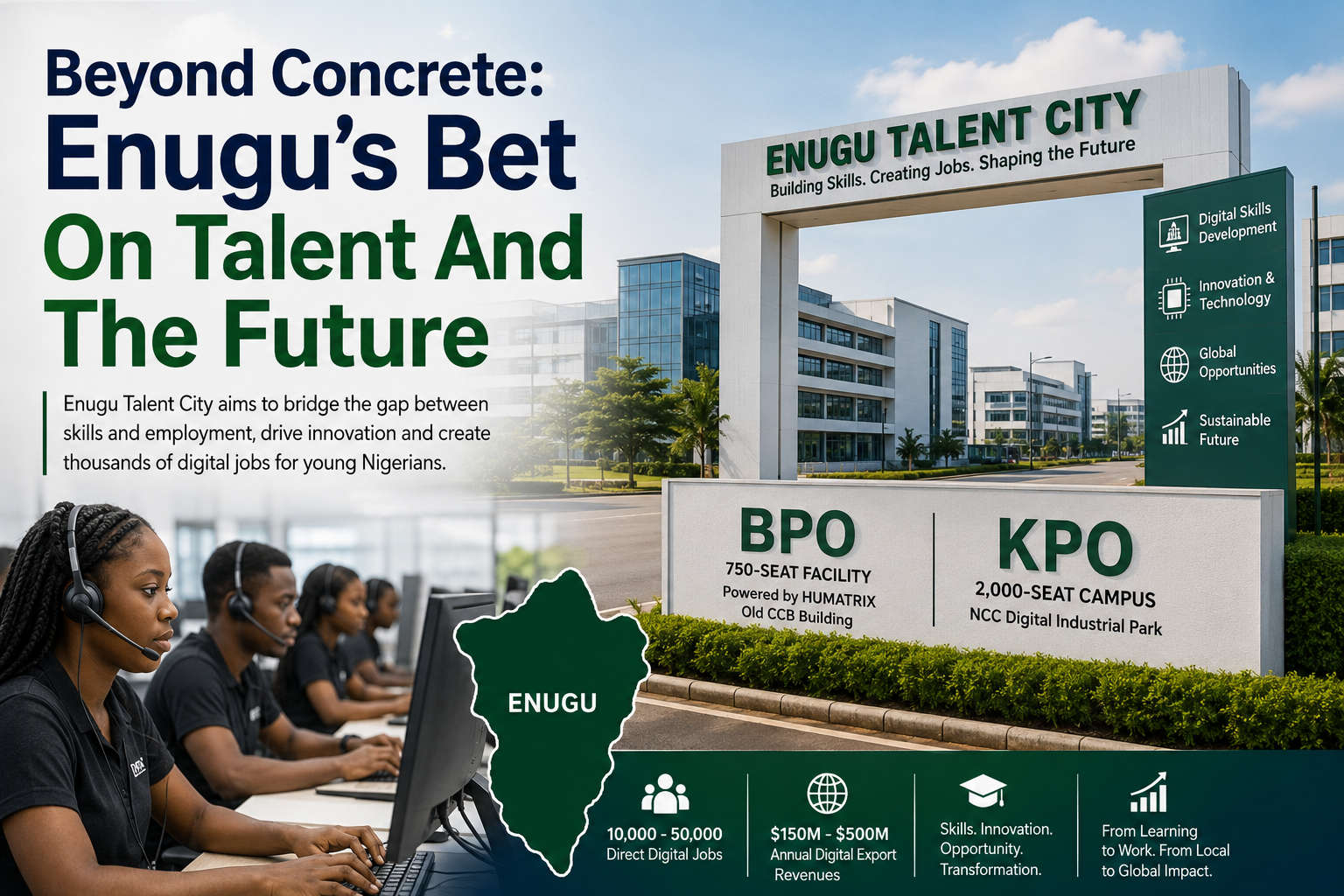
At the centre of the project are a 750-seat Business Process Outsourcing (BPO) facility at the Old CCB Building, anchored by HUMATRIX, and a 2,000-seat Knowledge Process Outsourcing (KPO) campus at the Nigerian Communications Commission Digital Industrial Park.
The facilities are expected to support areas such as customer service, finance, technical support, software development, artificial intelligence, cloud computing, cybersecurity and data analytics.
Rather than measuring success by the number of people trained, the project aims to connect training directly to employment, career progression and international markets.
The model could provide young people with a pathway from entry-level digital jobs to more specialised careers and eventually entrepreneurship.
However, the success of the initiative will depend on more than buildings and equipment. Reliable electricity, internet connectivity, cybersecurity, data protection, skilled personnel and strong private-sector management will be essential for the project to compete internationally.
The initiative also carries broader implications for other Nigerian states. Its most valuable lesson may not be the construction of another technology hub, but the idea of designing skills programmes around actual market demand.
Enugu Talent City has been associated with ambitious targets of 10,000 to 50,000 direct digital jobs and $150 million to $500 million in annual digital export revenues.
These remain targets that will ultimately need to be tested by actual jobs created, businesses attracted, workers retained and revenue generated.
If successfully implemented, the project could demonstrate that development is not only about roads and buildings but also about creating the skills, institutions and opportunities that enable people to build sustainable careers.
The real goal is simple: move talent from learning to employment, from employment to expertise, and from expertise to enterprise and global opportunity.