


















EOTV Brand Content | Business & Technology
Enugu is increasingly attracting attention as a destination for manufacturing, technology and investment, and one of the latest developments putting the city in the spotlight is the launch of a new Haier factory.
In February 2026, the Enugu State Government announced the inauguration of a $20 million Haier factory established through a partnership between the state government and Haier Global Business.
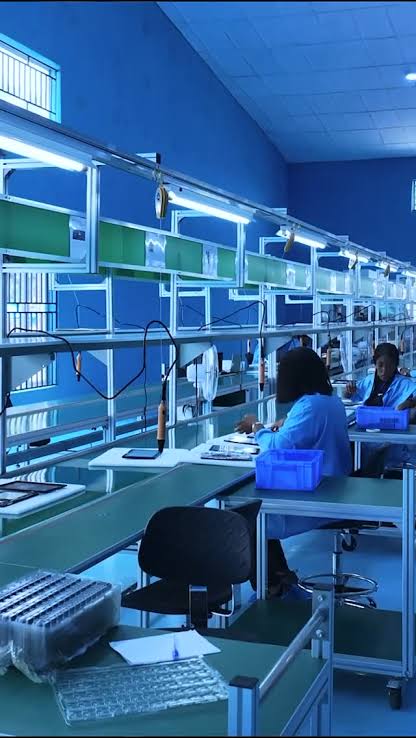
The facility is designed to produce technology-related products including smartphones, tablets, computers, smart boards and Android televisions, alongside medical and renewable-energy technologies. According to Haier, the factory has a designed production capacity of 200,000 units annually.
But beyond the factory itself, the bigger question is what such an investment could mean for Enugu’s manufacturing and technology ecosystem.
From Consumer Market to Production Hub
For years, Nigerian consumers have largely encountered technology as imported products.
Phones, computers, televisions, tablets and other electronic devices are commonly brought into the country from manufacturing centres outside Nigeria.
The arrival of a major technology manufacturing facility in Enugu introduces another possibility: that some of the products used by Nigerians could increasingly be produced locally.
The Enugu State Government says the Haier investment is intended to support the development of Made-in-Enugu technology, while also strengthening local capacity and reducing dependence on imported devices.
Whether the factory ultimately achieves that scale will depend on production, market demand, supply chains, skills and the wider business environment. But the investment itself represents a significant development in Enugu’s industrial story.
What Will the Haier Factory Produce?
According to Haier Vice President Sun Yongle, the Enugu facility is focused on ICT products, medical equipment and new-energy products.
The products identified by the company and the Enugu State Government include:
- Smartphones
- Tablets
- Computers
- Smart boards
- Android televisions
- Education technology
- Health technology
- Renewable-energy solutions
Haier has stated that the facility is designed to produce up to 200,000 units of various product lines every year.
That production capacity could create opportunities beyond the factory itself, particularly for businesses involved in logistics, distribution, maintenance, retail, technical services and other parts of the supply chain.
Jobs and Skills for Young People
One of the most closely watched aspects of the investment will be employment.
Haier said the facility would employ more than 100 local workers when fully completed, including sales and service teams, with the company’s broader plan indicating that total employment could exceed 200 employees.
But the potential impact may extend beyond direct employment.
Haier also announced plans for a Research and Development Centre and a training centre, with free training and internship opportunities for students in Enugu State. (Enugu State
For a city with universities, polytechnics, technical schools and a growing technology community, access to industrial training could be particularly significant.
Students who study electronics, computer science, engineering, ICT and related disciplines could potentially gain exposure to real-world manufacturing and technology operations.
A Potential Boost for Enugu’s Technology Ecosystem
A factory does not operate in isolation.
Around a large manufacturing operation, there can be opportunities for smaller businesses supplying goods and services.
These could include:
Logistics companies transporting components and finished products.
Technical service providers handling maintenance and repairs.
Technology businesses developing software and digital services.
Retailers and distributors selling locally produced devices.
Training centres preparing young people for technical roles.
Small manufacturers supplying packaging and other supporting materials.
This is one reason the Haier investment could have a wider effect than the number of people directly employed at the factory.
The real economic impact will depend on how strongly these connections develop over time.
Haier’s Investment Could Go Beyond Technology
The February 2026 announcement also indicated that the Enugu factory is only the first stage of Haier’s proposed investment in the state.
Haier Vice President Sun Yongle said the company was discussing additional cooperation in areas including agriculture, mining and transportation, with total investment in Enugu expected by the company to exceed $30 million if those plans materialise.
These are plans and discussions rather than completed investments, so their eventual impact will depend on implementation.
Still, the announcement suggests that Haier’s interest in Enugu could extend beyond electronics.
Connecting Manufacturing With Education
Another interesting part of the project is its connection with education.
The Enugu State Government said it placed offtake orders for more than 25,000 all-in-one desktop computers and 300,000 tablets as part of efforts to support its Smart Green Schools programme and encourage the investment.
If such technology is produced locally, it could create a direct link between manufacturing and education within the state.
Rather than simply importing devices for schools, the broader model could involve local production, technical training, servicing and potentially research and development.
That could give young people opportunities to see technology not only as something they consume, but also as something they can design, assemble, maintain and develop.
What Could This Mean for Enugu?
The Haier factory arrives at a time when Enugu is also pursuing a broader digital-economy agenda.
In August 2026, the Nigerian Communications Commission and Enugu State Government announced a 15-year lease arrangement involving the NCC’s Digital Industrial Park and Learning Centre. The state said the facilities would be developed as the Enugu Talent City and Artificial Intelligence Institute, with a focus on digital skills, startups, research and technology-enabled businesses.
Taken together, these developments point toward an ecosystem that combines manufacturing, technology, education, skills development and entrepreneurship.
The success of that ecosystem, however, will depend on how effectively these facilities are operated, how much local talent is developed and whether more private companies choose to invest in the state.
Why This Matters to Enugu Residents
For residents, the most important question is not simply how much money is being invested.
It is what the investment eventually produces for ordinary people.
Will more young people gain technical skills?
Will local businesses become suppliers?
Will technology products become more accessible?
Will more companies choose Enugu as a manufacturing base?
Will local universities and technical institutions connect more closely with industry?
And will the city develop businesses that can grow around these new investments?
Those questions will take time to answer.
But the establishment of the Haier factory provides a new piece of infrastructure around which some of those opportunities could develop.
A New Chapter for Enugu Manufacturing?
Enugu has a long industrial history, but the new Haier facility introduces a different dimension: technology manufacturing.
The factory’s planned focus on ICT, health and renewable-energy products places it at the intersection of several industries that are becoming increasingly important to Nigeria’s economy.
For Enugu, the opportunity is potentially bigger than having another factory within the city.
If local skills, suppliers, entrepreneurs, educational institutions and investors connect successfully around the facility, the project could become part of a broader manufacturing and technology ecosystem.
For now, the Haier factory is a new investment with ambitious plans. Its long-term significance will ultimately be measured by what it produces, the jobs and skills it creates, the businesses that grow around it and how deeply it becomes connected to Enugu’s economy.
One thing is already clear: Enugu’s manufacturing story is entering another chapter, and technology is now becoming part of that story.
——————————
EOTV Business & Brand Content
EOTV’s Brand Content section highlights businesses, companies, entrepreneurs, products, innovations and developments shaping Enugu and beyond.
Is your company building something interesting?
Contact Enugu Online TV for brand features, sponsored articles, business publicity, advertising and event coverage.
📧 Email: [email protected]
📞 WhatsApp: 0904 735 0925, 0810 131 6804