





















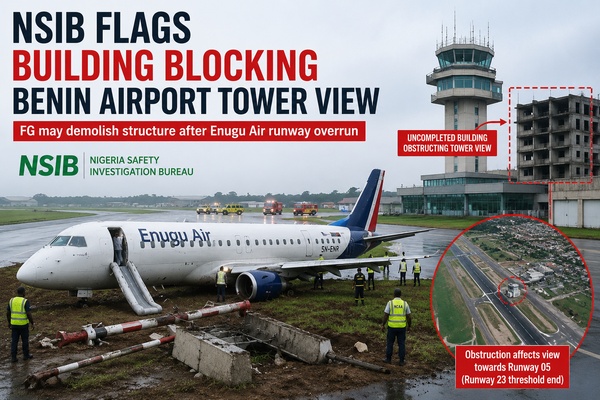
The Federal Government may be forced to remove an unfinished building that is obstructing the line of sight from the control tower at Benin Airport, following safety concerns raised after a runway overrun involving an Enugu Air aircraft.
The Nigeria Safety Investigation Bureau (NSIB) raised the concern in its latest preliminary report on the July incident, identifying the structure as one of several hazards requiring urgent attention at the airport.
According to the bureau, the uncompleted building obstructs air traffic controllers’ view towards the end of Runway 05, particularly the threshold area of Runway 23.
The safety concern emerged during investigations into the Enugu Air incident in which an Embraer ERJ 170-100LR, registered as 5N-ENR, ran beyond the runway after landing at Oba Akenzua II Airport in Benin.
The aircraft was operating flight ENU4264 from Murtala Muhammed International Airport, Lagos, when it overran Runway 05 shortly after touchdown.
All 68 occupants, comprising 63 passengers and five crew members, reportedly evacuated the aircraft safely using emergency slides. No injuries were recorded.
The NSIB investigation found that the aircraft’s autobrake system was not operational at the time of landing, meaning the crew had to rely on manual braking.
The aircraft had been cleared for commercial operations and possessed a valid Certificate of Airworthiness. The crew members were also properly licensed and qualified, while the flight’s take-off, climb, cruise and descent were reported to have been normal.
However, weather conditions deteriorated as the aircraft approached Benin. Investigators reported moderate rainfall and reduced visibility, while flight recorder data indicated a tailwind during the final approach and landing.
The air traffic controller reportedly informed the crew that the approach to Runway 23 appeared more favourable than the approach to Runway 05. Despite acknowledging the information, the pilots proceeded with the RNAV approach to Runway 05.
The controller also informed the crew before landing that the runway was wet. However, the NSIB noted that the communication did not include a formal Runway Condition Report or Runway Condition Code.
Flight data showed that the aircraft crossed the Runway 05 threshold at a radio altitude of approximately 93.5 feet before touching down about 1,641.5 metres from the threshold.
With insufficient runway remaining to stop safely, the aircraft continued beyond the paved surface and entered an unprepared area. It subsequently struck approach-lighting equipment and two concrete structures linked to a decommissioned localizer installation.
Following its preliminary findings, the NSIB issued four immediate safety recommendations, numbered A-2026-039 to A-2026-042.
The recommendations were directed to the Nigerian Civil Aviation Authority, Federal Airports Authority of Nigeria and Nigerian Meteorological Agency, and cover issues including the environment around the runway end, the control tower’s visibility and access to weather information.
The bureau also released a preliminary reconstruction of the aircraft’s flight path using available flight data.
The NSIB stressed that the report represents an ongoing investigation and should not be interpreted as a final determination of responsibility.
It reiterated that the purpose of an aviation safety investigation under international standards is to prevent future accidents and incidents, rather than assign blame or establish liability.