










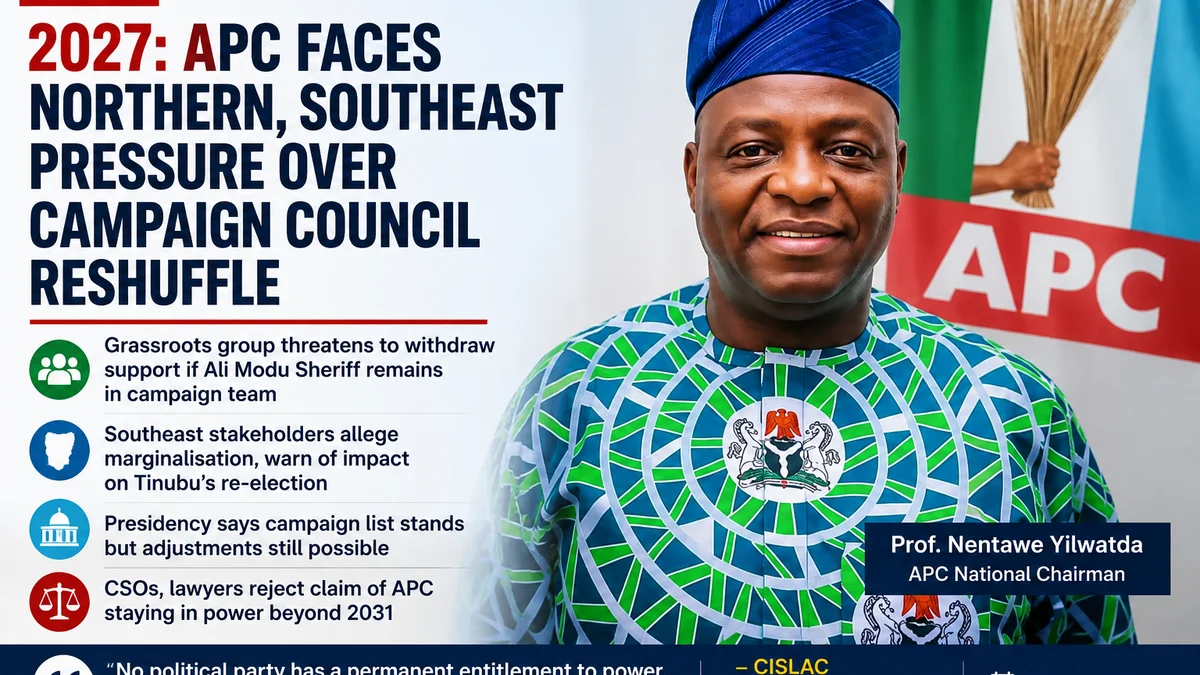
The ruling All Progressives Congress (APC) is facing growing criticism over the composition of its 2027 presidential campaign council, with concerns from groups in the North and Southeast putting pressure on the party to review some of its appointments.
The Presidency has acknowledged that adjustments may still be made to the 223-member campaign structure, even though the APC has maintained that the list remains valid.
The controversy intensified after the Grassroots Movement for Tinubu Continuity Come 2027 threatened to suspend its voluntary mobilisation activities if former Borno State Governor, Senator Ali Modu Sheriff, continues as the North-East Zonal Campaign Coordinator.
In a complaint dated August 25 and addressed to the APC national chairman, the group said its support for President Bola Tinubu's re-election remained strong but that it could not continue its grassroots efforts under the current arrangement.
Its National Chairman, Sani Zangina, said the organisation's objection was specifically directed at Sherif's role in the campaign structure. He cited concerns over allegations that have previously linked the former governor to Boko Haram, saying the issue could affect the campaign's image and public confidence in the North-East.
The development followed similar concerns raised by the Nigeria Rescue & Renewal Movement over Sheriff's inclusion in the campaign council.
Meanwhile, former South-East spokesman for the Tinubu-Shettima Presidential Campaign Council, Denge Onoh, has also criticised the composition of the newly announced council.
Onoh alleged that key APC stakeholders and long-standing supporters from the Southeast had been sidelined. He argued that the structure did not sufficiently reflect the contributions of regional campaigners who worked for Tinubu during the 2023 presidential election.
He described the new arrangement as being driven by personal interests and alleged marginalisation, warning that such a structure could weaken the President's support base ahead of the 2027 poll.
Onoh also questioned the strength of the campaign's media and communications team. He argued that the structure needed more experienced political communicators capable of responding effectively to opposition messaging and public relations campaigns.
The criticism has prompted clarification from the Presidency.
Speaking on Channels Television's Sunrise Daily, the Special Adviser to President Tinubu on Media and Public Communication, Sunday Dare, said the campaign structure had not been withdrawn and remained subject to further changes.
Dare explained that several subcommittees were yet to be constituted and that additional individuals could therefore be added to the campaign structure.
He said the APC had also confirmed that the original list remained in place, while stressing that it was not a final or unchangeable arrangement.
Under the structure announced over the weekend, President Tinubu serves as chairman, while Vice-President Kashim Shettima and APC National Chairman, Nentawe Yilwatda, were appointed vice chairmen.
Beyond the debate over individual appointments, civil society organisations, lawyers and opposition figures have also challenged recent comments suggesting that the APC could remain in power beyond 2031.
Their reaction followed a declaration by the Director-General of the APC Presidential Campaign Council, Senator Abdul'Aziz Yari, that the ruling party would continue to govern Nigeria beyond 2031.
The Executive Director of the Civil Society Legislative Advocacy Centre (CISLAC), Auwal Rafsanjani, described the statement as political optimism but warned against presenting future election results as predetermined.
Rafsanjani stressed that political power ultimately rests with Nigerian voters and that no political party has a permanent claim to govern the country.
He said credible, competitive, free and fair elections should determine who leads Nigeria in 2027, 2031 and subsequent election cycles.
The CISLAC executive director further warned that statements suggesting guaranteed electoral victories could weaken public confidence in democracy and discourage citizens from participating in elections.
He urged the APC and other political parties to consider the lessons from recent electoral contests, including the Osun governorship election, which he said demonstrated that voters should not be taken for granted.
With the 2027 election approaching, the criticism surrounding the APC campaign council is likely to keep attention focused on how the ruling party balances regional representation, political experience and campaign strategy as it prepares for the contest.