




















By Isaac Mission
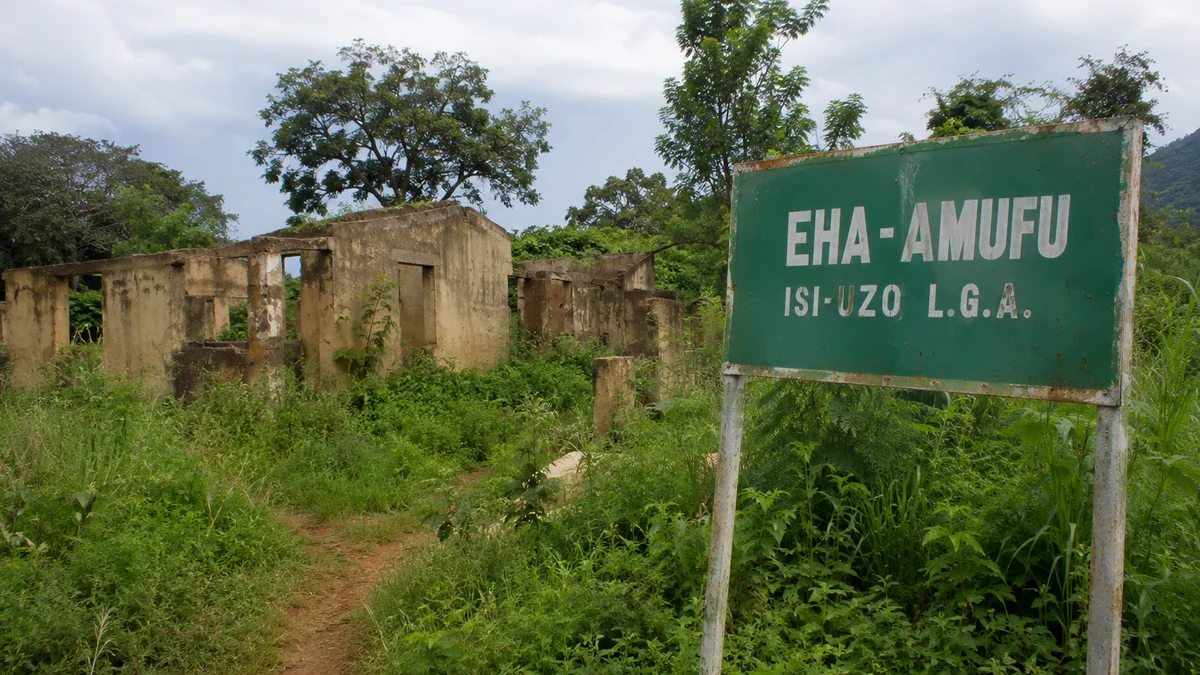
Four years after deadly attacks forced residents from several farming communities in Eha-Amufu, Isi-Uzo Local Government Area of Enugu State, many of the affected settlements remain largely deserted, with returning farmers still battling insecurity and cattle invasion.
An investigative visit to the area on August 19 found abandoned homes, overgrown compounds, damaged religious buildings and a largely inactive market along a newly constructed 21-kilometre road linking the affected communities.
The road, built by the Enugu State Government under Governor Peter Mbah, was intended to improve access and support security operations in the area. However, the settlements it passes through remain a shadow of their former selves.
The investigative team travelled by commercial motorcycle for about two hours through 10 farm settlements, including Orie Ogbete Mgbuji, Ukwuekwu-Mgbuji, Ekpufu-Mgbuji, Onungbede and Amuogbu Ebo.
Residents said the violence that occurred years ago displaced thousands of people, many of whom have yet to return permanently.
Abandoned homes and farms
Human activity was particularly sparse during the visit. Only a handful of people were seen around the village centres of Ukwuekwu-Mgbuji and Ekpufu-Mgbuji.
At Ogbete Mgbuji, once a major trading centre serving communities in Enugu and neighbouring Benue State, the market has remained closed since the violence.
An abandoned Anglican church in the community has reportedly been converted into a base for a joint security operation involving the military, police, Nigeria Security and Civil Defence Corps, state Forest Guards and local vigilantes.
Despite the security presence, residents said they continue to fear returning to their ancestral homes.
Security personnel stationed at the Ogbete outpost told SaharaReporters that cattle are frequently driven into cultivated farmlands, particularly at night, resulting in significant crop losses.
One security official, who spoke anonymously, cited an incident in which cattle reportedly destroyed more than five hectares of rice cultivated by returning residents.
The residents, according to the official, sought government protection and an end to repeated destruction rather than confrontation with the herders.
However, affected farmers said the response has often been limited to contacting local Fulani leaders to remove the cattle, leaving farmers to absorb the financial losses.
‘We cannot return home’
Nkechi Onunze, a resident of Onungbede-Mgbuji, said her family's home was among those destroyed during the attacks.
She explained that she now visits the abandoned settlement mainly to harvest crops because her family is struggling financially.
According to her, no government agency has provided assistance to rebuild the destroyed houses.
She said most former residents are currently living with relatives or in other communities.
Onunze added that the continued presence of armed herders and the destruction of crops have made permanent resettlement difficult.
She also complained about the cost of travelling between her current location and the abandoned farm settlement to cultivate or harvest crops.
Her appeal was for authorities to strengthen security and create conditions that would allow displaced families to safely return.
Survivor recounts attack
Sunday Ajah, a native of Ekpufu-Mgbuji who survived one of the attacks, accompanied the investigative team during the visit.
Ajah recalled encountering armed attackers after they blocked a road and began attacking people.
He said his motorcycle was taken and set ablaze, while several people were killed during the incident.
He described escaping into the bush as a terrifying experience, saying he was unsure whether he would survive.
The attacks, he said, scattered families across churches, schools and relatives' homes.
Ajah also said cattle continue to enter farmlands in the area, recalling an incident in which a rice farm covering more than five hectares was allegedly destroyed overnight.
He called on the government to improve access roads and increase security operations around the affected settlements.
Ogbete market remains closed
Ajah also recalled the January 7, 2022 attack on Ogbete market, which he said effectively ended commercial activities there.
He claimed that armed attackers invaded the market while traders were conducting business, resulting in the deaths of several people, including women and children.
Before the attack, the market reportedly attracted traders from both Enugu and Benue states.
Four years later, Ajah said the market remains inactive, with many former residents only returning occasionally to collect belongings or harvest crops before leaving again.
He said he would be willing to return permanently if the government could improve the roads, security and general conditions in the area.
Ebo settlements also deserted
Ogbu Gabriel, who is from Amuogbu-Ebo, said several Ebo farm settlements remain virtually empty.
He listed Amuobelebe, Amuokpobe, Amuogbaga and Amuogbu among communities where residents have allegedly failed to return because of security fears and repeated destruction of crops by cattle.
According to Gabriel, some displaced residents have moved to cities, while others live with relatives and survive through casual labour, farming for other people and construction work.
He rejected claims that residents have fully returned to the affected settlements.
Gabriel also alleged that homes, schools and churches destroyed during the attacks have not been rebuilt.
He said some farmers who ventured into the area to cultivate their land allegedly went missing, with some bodies later recovered.
Residents living in fear
At Ukwuekwu-Mgbuji, Sunday Ogbuabor said some residents have returned but continue to live with anxiety.
He alleged that cattle regularly enter farms and destroy crops, citing a recent incident involving more than 50 cows.
Ogbuabor said residents remain afraid, particularly at night, despite the presence of security personnel.
He said his own house was vandalised and its roof damaged, forcing him to live in another person's home.
He appealed to the government to assist residents in rebuilding damaged houses and compensate farmers whose crops have been destroyed.
He also called for increased surveillance, including the use of drones to monitor the vast farming settlements and identify criminal activity.
Security intervention offers limited relief
Residents acknowledged that the joint security operation has provided some level of reassurance.
Ogbuabor said security personnel recently intervened after cattle entered cultivated farms, with the task force reportedly contacting the owner and ensuring the animals were removed within about 30 minutes.
However, residents said the recurring movement of cattle into farms, especially at night, remains a major concern.
The situation in Eha-Amufu presents a stark contrast between infrastructure development and the reality facing displaced residents.
While the newly constructed road provides improved access to the rural settlements and security forces maintain a presence in some areas, many homes remain abandoned and public facilities have deteriorated.
For residents, returning home requires more than roads and security checkpoints. They are demanding the reconstruction of destroyed homes and public facilities, stronger protection for farmers, accountability for crop destruction and sustained security operations.
Until those conditions are met, many displaced families remain dependent on relatives, casual work and temporary visits to their ancestral lands to harvest whatever crops they can salvage.