












By Isaac Mission
Enugu State is undergoing a major transformation that could significantly reshape its economic, social and physical identity in the years ahead.
Known for decades as Nigeria’s Coal City State, Enugu has a history deeply connected to coal mining, regional politics and commerce. But the state is now pursuing a broader development vision aimed at positioning it as an investment destination, technology-driven economy, healthcare hub and regional commercial centre.
Created on August 27, 1991, from the old Anambra State during the administration of former military Head of State, General Ibrahim Babangida, Enugu has evolved considerably since its creation.
Its history, however, goes much further back. The name Enugu is derived from the Igbo expression “Énú Ugwu,” meaning hilltop or top of the hill.
The discovery of coal around the Udi Hills in 1909 marked a decisive turning point. Coal transformed Enugu into an important industrial settlement, while the completion of the Eastern Railway connection to Port Harcourt in 1916 strengthened the city’s economic importance by providing a link between the coal-producing area and the coast.
Enugu later became the capital of the former Eastern Region and, during the Nigerian Civil War, served briefly as the capital of the Republic of Biafra.
A Changing Political Landscape
Since becoming a state in 1991, Enugu has passed through a succession of military and civilian administrations.
The return to democratic rule in 1999 ushered in a new phase, with Chimaroke Nnamani serving as governor between 1999 and 2007. He was followed by Sullivan Chime from 2007 to 2015 and Ifeanyi Ugwuanyi from 2015 to 2023.
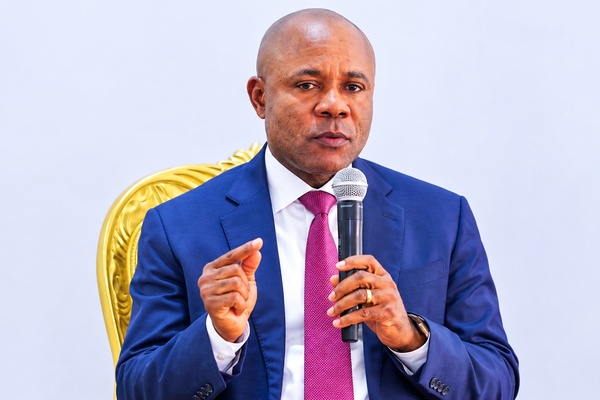
In 2023, Peter Ndubuisi Mbah assumed office as governor and introduced a development agenda built around the slogan, “Tomorrow Is Here!”
The administration's programme has since placed considerable emphasis on infrastructure, human capital development, healthcare, urban renewal, transportation, security, agriculture, technology and investment.
The $30 Billion Economic Target
One of the central ambitions of the current administration is to expand Enugu's economy from an estimated $4.4 billion to $30 billion.
Such an objective requires more than physical infrastructure. It calls for an environment capable of attracting private capital, supporting businesses, improving productivity and creating opportunities for residents.
This approach has informed a wide range of projects across the state.
Rebuilding the Education System
Education is one of the major areas receiving attention.
Through the Smart Green Schools initiative, the state is developing about 268 modern schools, with at least one planned for each of its 260 political wards alongside additional facilities in designated locations.
The schools are being conceived as technology-enabled learning environments, incorporating areas such as digital education, robotics and artificial intelligence.
The government is also establishing three technical and vocational colleges, with one located in each senatorial district. The objective is to equip young people with practical and technical skills that can translate into employment, entrepreneurship and participation in a technology-driven economy.
Expanding Healthcare Access
Healthcare infrastructure is another major component of the state's development plans.
The administration is constructing 260 Type-2 Primary Healthcare Centres across the state's wards. The facilities are expected to bring medical services closer to residents, particularly communities outside major urban centres.
The centres are designed to provide services involving doctors, nurses and midwives, as well as drug dispensaries, maternity facilities and bed spaces.
At the specialist level, the Enugu International Hospital is being developed to provide advanced medical services within the state.
The facility is expected to offer specialised services in areas including cancer treatment, nuclear and molecular medicine, cardiovascular and cardio-renal care, as well as maternal and child healthcare.
If fully operational at the envisioned scale, the hospital could strengthen Enugu's position as a referral and healthcare destination for the wider region.
The Vision for a New Enugu City
Among the most expansive projects associated with the current administration is the proposed New Enugu City.
The development covers approximately 10,000 hectares along the Enugu-Abakaliki Expressway and is planned as a modern urban centre incorporating residential, commercial and other supporting infrastructure.
The project is intended to provide room for population expansion while creating an environment capable of attracting businesses, investors and new economic activities.
It forms part of a wider road construction and rehabilitation programme covering urban and rural communities.
Major routes, including the Penoks-Abakpa-Opi Nsukka corridor, alongside roads across areas such as Nsukka, Igbo-Etiti and Udi, are being developed or rehabilitated with the stated objective of improving connectivity and opening up economic corridors.
Bringing Historic Assets Back to Life
The government is also seeking to revive some of Enugu's longstanding landmarks.
Projects involving the Hotel Presidential, Nigergas and the International Conference Centre are intended to restore important assets associated with the state's economic and social history.
A new five-star international hotel is also being developed close to the International Conference Centre.
The combination of hospitality, conference and urban infrastructure is expected to strengthen Enugu's prospects as a destination for business events, tourism and investment.
Rethinking Transportation
Transportation is another area undergoing significant change.
The introduction of Compressed Natural Gas buses and electric taxis is aimed at creating a cleaner and more modern public transport system.
The administration is also developing transportation terminals and interchanges at strategic locations, including Holy Ghost, Abakpa and Gariki.
Meanwhile, the Enugu Air initiative is expected to expand its fleet and develop cargo-handling capacity at Akanu Ibiam International Airport.
Together, these projects are designed to improve the movement of people and goods while supporting commercial activity.
Technology-Driven Security
Security is also being approached from a technological perspective.
Plans for an AI-supported security system include surveillance infrastructure, command centres and specialised operational vehicles.
The objective is to improve the ability of security agencies to identify threats, coordinate responses and use real-time intelligence in crime prevention and emergency management.
The approach represents a shift towards a more technology-based and intelligence-led security structure.
Water and Electricity as Economic Foundations
For many years, inadequate public water supply has remained one of Enugu's major infrastructure challenges.
The current administration has therefore embarked on investments intended to substantially increase water production and distribution across the urban area.
Electricity is another critical component of the development strategy.
The creation of the Enugu State Electricity Regulatory Commission is expected to support the development of a more organised electricity market within the state, with reliable power regarded as essential for businesses, industries and households.
Agriculture and Industrial Development
The state's economic plans also extend to agriculture and manufacturing.
One major initiative involves a proposed ₦100 billion investment to revive United Palm Products Limited.
There are also plans to establish 100,000 hectares of land-banked farmland in each senatorial district, creating room for large-scale agricultural production, agro-processing and other rural economic activities.
The emphasis on public-private partnerships is intended to bring private capital and expertise into sectors that can generate jobs and expand the state's economic base.
Building an Investment Ecosystem
Perhaps the defining feature of the current development strategy is the attempt to connect individual projects into a broader economic system.
Road infrastructure can improve access to markets. Schools can produce a better-skilled workforce. Hospitals can reduce the amount of money residents spend seeking specialised treatment elsewhere. Improved transportation can facilitate commerce, while reliable water and electricity can support businesses.
Urban development, hotels and conference facilities can attract investors, visitors and corporate events.
The digitisation of the state's land administration system also fits into this investment strategy by seeking to make land transactions more transparent, efficient and predictable.
For investors, easier access to reliable land records and faster transactions can influence decisions about where to commit capital.
A Transformation Still in Progress
The scale of the ongoing projects has changed the development conversation around Enugu, but their ultimate success will depend on implementation.
Large infrastructure programmes require sustained funding, effective management, maintenance and institutional continuity. Their impact will ultimately be measured not simply by the number of projects completed, but by whether those projects become productive assets that continue delivering value over time.
Enugu's transformation is therefore still a work in progress.
Yet the direction is increasingly visible.
A state historically associated with coal mining and its role in Nigeria's political history is seeking to build a new identity around technology, modern infrastructure, healthcare, investment, transportation, agriculture and urban development.
From the discovery of coal in Udi in 1909 and the railway connection to Port Harcourt in 1916, through its emergence as the capital of the Eastern Region and the former Republic of Biafra, Enugu has repeatedly occupied important positions in Nigeria's history.
Today, another chapter is unfolding.
The central question is no longer whether Enugu is changing, but whether the current momentum can be sustained long enough to deliver the economic transformation being promised.
If the projects underway are successfully completed, properly maintained and supported by strong institutions, the period could eventually be remembered as one of the most significant phases in Enugu's development history.
Kenneth Ofoma, Senior Special Assistant (SSA), Policy & Communication to the Governor of Enugu State, writes from Enugu.