





By Isaac Mission
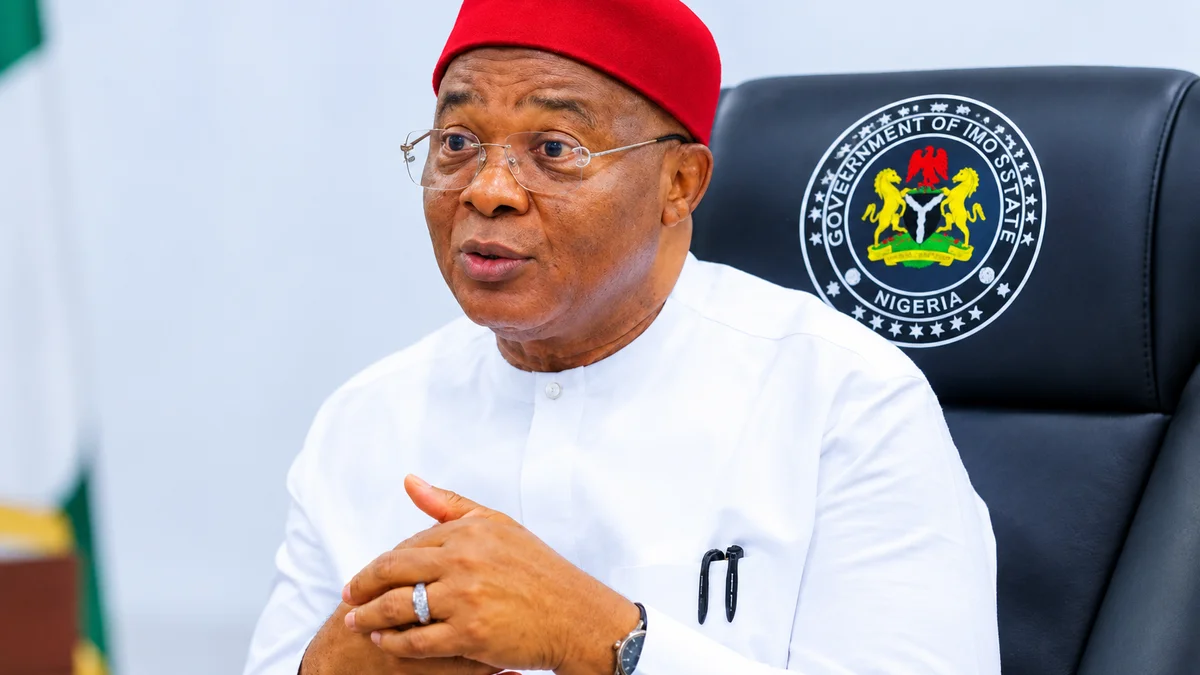
Governor Hope Uzodimma of Imo State is facing a complex political road as he prepares to pursue a return to the Senate in 2027, with a constitutional question, a legal challenge from former governor Rochas Okorocha and an emerging succession battle within the All Progressives Congress (APC) adding to the uncertainty.
Uzodimma, who commenced his second term as governor in January 2024, is expected to remain in office until January 2028. However, the proposed inauguration of the 11th National Assembly in June 2027 could create a constitutional dilemma if he wins the Imo West senatorial election.
The timing would leave several months between the inauguration of the National Assembly and the end of his tenure as governor.
Section 183 of the 1999 Constitution provides restrictions on a serving governor holding another executive office or paid employment. Legal arguments surrounding the situation suggest that Uzodimma would have to relinquish the governorship before taking his seat in the Senate if he emerges victorious.
One option reportedly being considered within his political camp is for the governor to resign and allow his deputy to complete the remaining months of the administration.
While such a move could resolve the constitutional issue, it could create a new political challenge, particularly as the governor is expected to have a strong interest in determining the direction of the state ahead of the 2028 governorship election.
Uzodimma is no stranger to the National Assembly. He represented Imo West in the Senate from 2011 to 2019 before becoming governor in January 2020 following a Supreme Court decision.
His attempt to return to the same senatorial district has, however, brought him into another political confrontation with Okorocha, his predecessor as governor.
At the APC senatorial primary conducted in May 2026, Williams Kayode, chairman of the party’s National Assembly Primary Election Committee, declared Uzodimma the winner with 230,464 votes.
But Okorocha has challenged the outcome.
On August 13, 2026, the former governor filed a case, FHC/ABJ/CS/1854/2026, at the Federal High Court in Abuja against the Independent National Electoral Commission (INEC), Uzodimma and the APC.
Okorocha is contesting the result of the primary, claiming that he secured 150,780 votes against Uzodimma’s 102,158. He is asking the court to overturn the published result and recognise him as the APC's candidate.
He has also raised a constitutional challenge against Uzodimma's eligibility to contest the election while serving as governor. His argument is that a candidate who may be constitutionally unable to assume the senatorial position when the new National Assembly is inaugurated should not be allowed to contest.
The court's decision could therefore have significant implications for the APC's plans in Imo West and Uzodimma's political future beyond his tenure as governor.
Beyond the legal battle, another major issue confronting the governor is the question of who will control the state during the final months of his administration if he leaves office to take up a Senate seat.
If his deputy is allowed to complete the tenure, the deputy would wield the powers of the governor for roughly seven months. This could create an independent political centre at a time when various interests within the APC would already be positioning themselves for the 2028 governorship race.
Another possibility would be an attempt to install a trusted political ally in the transition period. Such a move, however, could generate resistance within the party and intensify disagreements over who should succeed Uzodimma.
At the centre of the succession debate is the proposed charter of equity, which advocates rotation of the governorship among Imo State's three senatorial zones.
Stakeholders from different parts of the state have continued to debate where political power should move after Uzodimma's tenure. With the governor's Owerri zone having previously produced a governor, voices from Orlu and Okigwe have argued that their zones should be considered in the next power-sharing arrangement.
Uzodimma's handling of the transition could therefore influence the 2028 contest and determine the level of support he receives from different blocs within the APC.
Allowing his deputy to remain in charge could reduce tensions over constitutional succession but may also limit the governor's direct influence during the final months of his tenure. Conversely, seeking greater control over the transition could help protect his political interests while potentially provoking opposition from party stakeholders.
For Uzodimma, the challenge is therefore not limited to securing the APC ticket or defeating Okorocha's legal challenge. He must also navigate the constitutional requirements surrounding his possible move to the Senate while managing competing interests over his eventual successor.
How the governor handles the court case, the deputy-governor question and the charter of equity debate could ultimately determine whether his Senate ambition strengthens or weakens his influence over Imo politics beyond 2027.