















By Isaac Mission
First Lady Senator Oluremi Tinubu has received two additional traditional honours in the South-East, adding to a growing list of titles bestowed on her by traditional institutions across different parts of Nigeria.
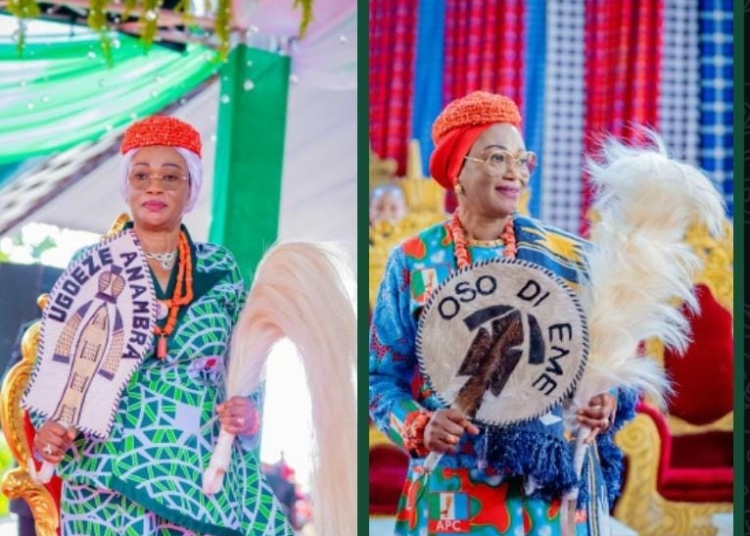
The latest recognitions came within 48 hours. In Imo State, the Council of Traditional Rulers honoured her with the title Oso Di Eme, interpreted as a woman who supports her husband. The following day in Anambra State, she was given the title Ugoeze by the state’s traditional rulers.
The recognitions have drawn attention to the First Lady’s increasing engagements with communities outside the Federal Capital Territory and her involvement in empowerment, welfare and development programmes.
According to the Leadership commentary, the recent honours are part of a wider pattern. The writer noted that Senator Tinubu has received traditional titles in several states during the past three years, including Gombe, Enugu, Osun, Delta, Niger, Imo and Anambra.
Among the previously reported honours are Sarauniyar Yaki, meaning Queen Warrior, from the Akko Emirate in Gombe; Ugosimba I in Enugu; and Yeye Asiwaju Gbogbo Ile Yoruba, conferred by the Ooni of Ife, Oba Enitan Adeyeye Ogunwusi.
She was also honoured by the Itsekiri traditional institution in Delta State and received the title Soniyanko Nupe from the Etsu Nupe in Bida, Niger State.
The writer argued that the spread of these honours across different regions and cultural traditions reflects the First Lady’s increasing visibility and engagement with communities across the country.
Her recent visit to the South-East also featured several empowerment and social intervention programmes.
In Imo, she participated in the distribution of business equipment to women across the five South-East states. The programme provided items including freezers, gas cookers, generators and grinding machines to 500 women in each state, bringing the total number of beneficiaries to 2,500.
She also announced a personal donation of N250 million to support the beneficiaries.
In Anambra, Senator Tinubu launched the South-East phase of the National Community Food Bank Programme, an initiative aimed at addressing child malnutrition.
The launch was significant because it marked the completion of the programme’s rollout across Nigeria’s six geopolitical zones, according to the article.
The First Lady’s activities in Anambra extended to education and technology. At the Federal Polytechnic, Oko, she inaugurated a new RHI and TETFUND ICT Experience Centre and interacted with students, encouraging them to make productive use of emerging technologies, including artificial intelligence.
She also participated in the distribution of empowerment support by the Anambra State Government to 5,000 beneficiaries, with each recipient receiving a N100,000 grant.
The article further highlighted Senator Tinubu’s interaction with Governor Charles Soludo and his wife, noting that she publicly acknowledged their programmes despite the political differences between the All Progressives Congress-led Federal Government and the Anambra State administration.
According to the writer, her call for political differences to be set aside when addressing citizens’ needs represents an approach that could become increasingly important as Nigeria moves closer to the 2027 elections.
Beyond the ceremonies surrounding the traditional titles, the commentary argued that such recognitions carry significance because traditional institutions operate according to established customs and community expectations.
The writer maintained that the honours received by Senator Tinubu across different parts of Nigeria reflect the perception of her contributions by traditional rulers and communities.
From empowerment initiatives and food intervention programmes to education and technology projects, the article portrayed the First Lady as someone who has chosen to use the office beyond its conventional ceremonial functions.
The commentary concluded that her latest honours in Imo and Anambra further reinforce the growing recognition of her activities across the country, describing the titles as acknowledgements that, in the writer’s view, are earned through sustained engagement with communities.