










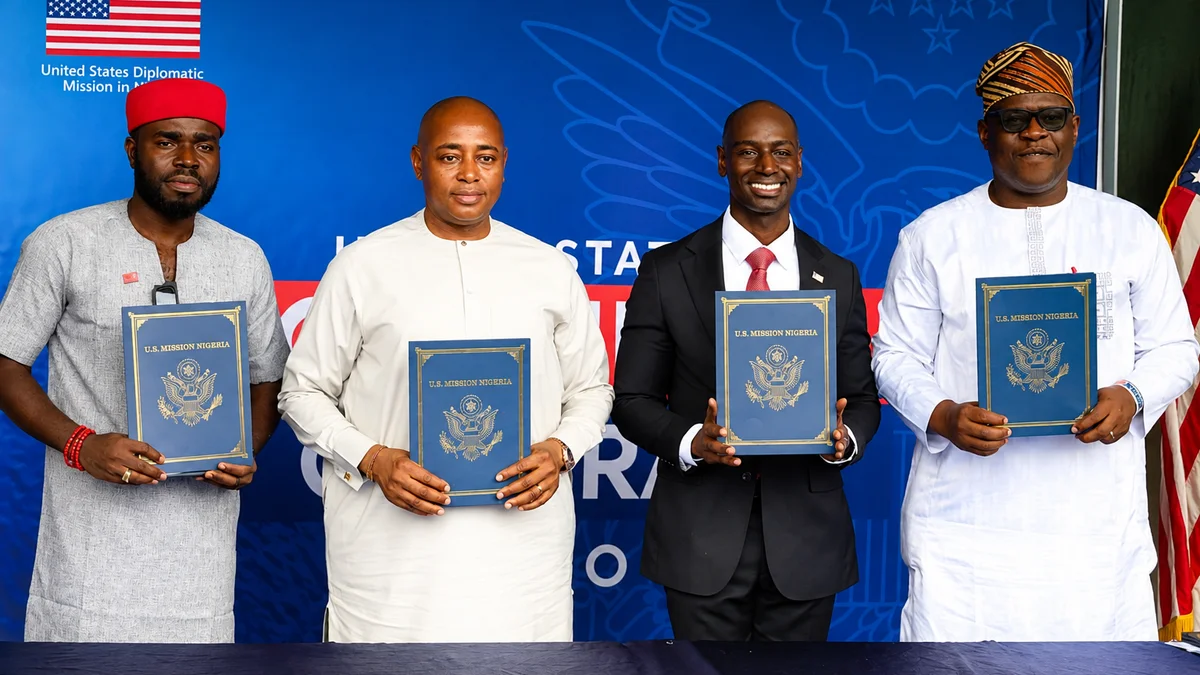
The United States government has awarded a $125,000 grant to support the preservation and digital documentation of the ancient Lejja Iron-Smelting Site in Enugu State.
The funding, provided through the U.S. Ambassadors Fund for Cultural Preservation (AFCP), was awarded to the Centre for Memories in Enugu for a project focused on protecting the archaeological site and documenting its historical significance.
Known as the “Nchekwaba: Lejja Iron-Smelting” project, the initiative will combine physical conservation with 3D digital documentation of the site, which is believed to date back to around 2000 BC.
The site is regarded as important evidence of the technological abilities and industrial activities of ancient communities in what is now Nigeria.
The project is being led by Centre for Memories Executive Director Iheanyi Igboko, an alumnus of a US-supported cultural exchange programme.
Speaking at the project launch in Lagos, U.S. Consul General Brandon Hudspeth described Lejja as a significant record of thousands of years of innovation and technical knowledge.
Hudspeth said the latest grant was part of the longstanding cultural partnership between Nigeria and the United States.
He disclosed that the US had committed approximately $1.2 million to cultural heritage preservation projects in Nigeria over the past five years, largely through the Ambassadors Fund for Cultural Preservation.
According to him, the investment goes beyond traditional development assistance, describing cultural preservation as an intervention capable of generating economic and social benefits for both countries.
The launch was attended by Enugu State Deputy Governor Ifeanyi Ossai, officials of the Federal Ministry of Arts, Culture, Tourism and the Creative Economy, the National Commission for Museums and Monuments, ICOMOS Nigeria, the Smithsonian Institution’s National Museum of African Art and other cultural heritage organisations.
Igboko said the project would go beyond preserving archaeological remains by also documenting the traditions, oral accounts, indigenous knowledge and community practices associated with Lejja.
He stressed that the community and researchers had long been involved in preserving and studying the site, adding that the new initiative would provide a stronger institutional and technical framework for bringing those efforts together.
The preservation project also builds on the Cultural Heritage Forward programme, supported by the U.S. Department of State in partnership with the Smithsonian Institution.
The programme facilitates knowledge sharing between Smithsonian specialists, Nigerian museum professionals and community-based heritage practitioners, with the aim of strengthening expertise and networks for protecting Nigeria’s cultural assets.
Nigeria and the United States are also cooperating under a 2022 Cultural Property Agreement, which restricts the importation of certain Nigerian archaeological and ethnological materials into the US.
The agreement is designed to help combat the looting and illicit trafficking of Nigerian cultural property while encouraging cooperation between law enforcement agencies and cultural institutions.
The US Mission has reportedly begun discussions with Nigerian authorities on extending the agreement for another five years, signalling continued collaboration on the protection of Nigeria’s archaeological and cultural heritage.