

-1200x675.webp)









By Isaac Mission
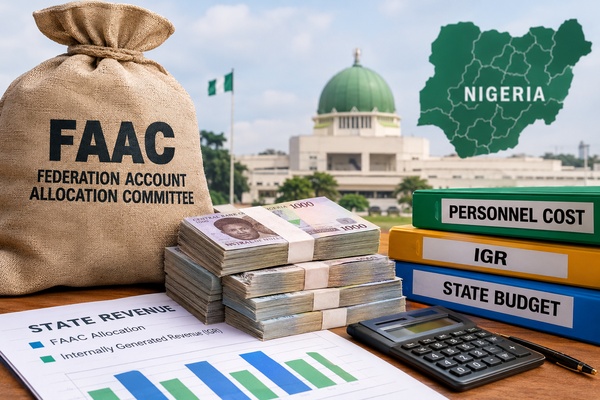
At least 26 Nigerian states were unable to generate enough Internally Generated Revenue (IGR) to cover their personnel expenditure in 2025, highlighting the continued dependence of many state governments on allocations from the Federation Account.
A review of state financial data contained in a 2026 BudgIT report showed that only eight of the 34 states assessed generated more IGR than they spent on personnel during the year.
The states that recorded sufficient internally generated revenue to cover their wage bills were Lagos, Enugu, Ogun, Delta, Kaduna, Kwara, Abia and Anambra.
Collectively, the other 26 states generated approximately N1.16 trillion in IGR but spent about N1.91 trillion on personnel, resulting in a funding gap of roughly N747 billion.
The figures were contained in BudgIT's report, titled Nigeria's Economic Reforms: What Has Changed Across Nigeria's States? An Analysis of State Finances in the Post-Subsidy Years.
The analysis compared actual budget implementation figures from 2022 and 2025. Akwa Ibom and Rivers were not included because complete or reliable data for the states was unavailable.
The report does not suggest that states should pay salaries exclusively from internally generated revenue, as statutory allocations from the Federation Account remain a legitimate source of public revenue. However, the figures demonstrate how difficult it would be for many states to meet their personnel obligations without federal transfers.
FAAC Dependence Rises Despite Revenue Growth
State revenues have increased significantly since the removal of the petrol subsidy and the implementation of foreign exchange reforms. However, the growth in federal allocations has outpaced the increase in IGR.
According to BudgIT, aggregate allocations from the Federation Account rose from N3.43 trillion in 2022 to N11.38 trillion in 2025, representing a 232.06 per cent increase.
During the same period, states' combined IGR increased from N1.57 trillion to N4.15 trillion, a 165.01 per cent rise.
As a result, FAAC's contribution to aggregate state revenue increased from 68.7 per cent in 2022 to 73.3 per cent in 2025. The contribution of IGR, meanwhile, dropped from 31.4 per cent to 26.7 per cent.
BudgIT warned that stronger domestic revenue mobilisation would be necessary if states are to achieve greater fiscal independence and reduce their vulnerability to changes in federal transfers.
Wide Differences Among States
The financial gap varied considerably across the states.
Yobe recorded one of the widest disparities, generating N15.42 billion in IGR while spending N76.34 billion on personnel. This left a difference of about N60.91 billion.
In Taraba, IGR stood at N17.89 billion compared with personnel expenditure of N55.60 billion. Sokoto generated N20.58 billion against personnel costs of N58.65 billion, while Adamawa recorded N24.14 billion in IGR against N65.73 billion in personnel expenditure.
Jigawa spent N92.66 billion on personnel despite generating N35.27 billion internally, while Benue's N29.38 billion IGR fell well below its N73.94 billion personnel expenditure.
Kogi generated N36.50 billion but spent N89.20 billion on personnel, while Kebbi recorded N18.41 billion in IGR against personnel costs of N44.82 billion.
Other states where personnel expenditure exceeded IGR included Bauchi, Bayelsa, Borno, Cross River, Ebonyi, Edo, Ekiti, Gombe, Imo, Kano, Katsina, Nasarawa, Niger, Ondo, Osun, Oyo, Plateau and Zamfara.
Oyo recorded the largest absolute gap among the 26 states, with N102.52 billion in IGR against personnel expenditure of N170.04 billion, representing a shortfall of about N67.51 billion.
Lagos, Enugu Lead States With Stronger IGR
Lagos remained the dominant contributor to the combined IGR figures.
The state generated N1.85 trillion in 2025, up sharply from N656.35 billion in 2022. Its IGR alone represented roughly 44 per cent of the N4.15 trillion generated by the 34 states covered in the analysis.
Lagos spent N333.67 billion on personnel, leaving its internally generated revenue more than five times its wage expenditure.
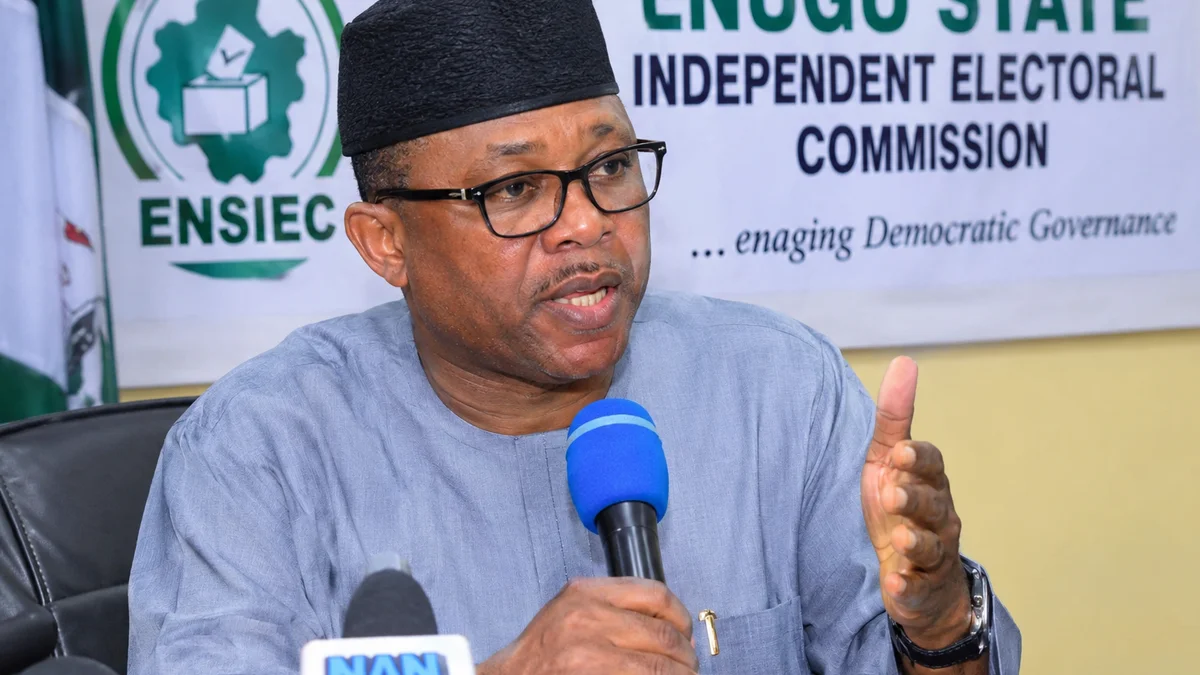
Enugu also recorded a major increase, generating N406.77 billion in IGR compared with personnel expenditure of N56.40 billion.
Ogun generated N237.65 billion against N151.27 billion in personnel costs, while Delta recorded N206.44 billion in IGR compared with N197.81 billion spent on personnel.
Kaduna generated N86.72 billion against N77.63 billion in personnel expenditure. Kwara recorded N85.21 billion in IGR against N65.22 billion in personnel costs, while Abia generated N66.86 billion against N62.26 billion. Anambra recorded N54.24 billion in IGR and N39.95 billion in personnel expenditure.
However, the huge contribution from Lagos significantly affects the overall picture. When Lagos is excluded, the remaining 33 states generated approximately N2.30 trillion in IGR against combined personnel expenditure of about N2.56 trillion.
Enugu Records Sharpest IGR Increase
Enugu recorded one of the most dramatic changes in internally generated revenue during the period under review.
Its IGR rose from N25.12 billion in 2022 to N406.77 billion in 2025, representing an increase of approximately N381.66 billion and a compound annual growth rate of 153.01 per cent.
BudgIT attributed much of the increase to proceeds recorded by the Enugu State Housing Development Corporation from the government's intervention in the state's landed property market.
The organisation, however, raised concerns about the classification of the receipts and noted that some of the revenue could be cyclical rather than a reflection of recurring internally generated income.
Niger also recorded significant growth, with IGR increasing from N12.11 billion to N66.37 billion, while Abia's revenue climbed from N14.67 billion to N66.86 billion.
Not all states experienced growth. Jigawa's IGR fell from N59.40 billion in 2022 to N35.27 billion in 2025. Sokoto also declined from N23.60 billion to N20.58 billion, while Ebonyi's revenue slipped from N23.89 billion to N23.25 billion.
Jigawa faced an additional challenge as its personnel expenditure increased from N52.37 billion in 2022 to N92.66 billion in 2025 while its IGR declined.
Experts Seek Stronger Fiscal Independence
The findings have renewed calls for states to develop stronger revenue bases and reduce excessive dependence on federal allocations.
Minister of Finance and Coordinating Minister of the Economy, Taiwo Oyedele, recently advocated stronger fiscal federalism, improved domestic revenue generation and economic diversification.
Oyedele also urged state governments to attract investments and create jobs while improving their capacity to generate revenue independently.
Former Vice-Chancellor of the University of Uyo, Prof Akpan Ekpo, similarly called on states to explore innovative ways of expanding their IGR, particularly by improving public services and creating conditions that encourage economic activity.
The Chief Executive Officer of the Centre for the Promotion of Private Enterprise, Muda Yusuf, warned that many states remained financially vulnerable without significant improvements in investment and revenue generation.
He also called for greater efficiency in public spending, including a review of large bureaucracies and excessive political appointments that place additional pressure on state finances.
The latest figures therefore point to a mixed fiscal picture: while many states have increased their revenues since 2022, a large number still lack sufficient internally generated resources to independently meet their personnel costs, leaving them heavily reliant on federal transfers.
-1200x675.webp)